A printer service contract transfers the financial risk of equipment failure from your warehouse to the service provider, but whether it’s worth the cost depends on your printer’s role in operations, your cash flow tolerance for unexpected repairs, and your team’s technical capabilities. For most small-to-medium logistics operations running mission-critical thermal printers like the Zebra ZT411 or Honeywell PD45, a well-structured service contract typically saves money while protecting uptime.
The Real Cost of Printer Downtime
Before deciding whether a service contract makes financial sense, calculate what a single hour of printer downtime costs your operation. If you’re a warehouse manager relying on thermal label printers to process shipments, every minute without printing capability cascades: orders don’t ship, staff stand idle, customers get delayed tracking information, and repeat customers slip away.
Industry tracking of logistics operations found that unplanned equipment downtime costs SMBs an average of $5,600 per hour in lost productivity. That number varies by facility size and complexity, but even a conservative estimate for a 50-person warehouse shows why a single unexpected printer failure can wipe out weeks of contract cost savings.
When a Zebra thermal printer fails at 2 p.m. on a Friday and you’re running a break-fix model, you’re choosing between:
Emergency service calls (often 2–4x standard rates)
Waiting until Monday (losing weekend shipments and customer goodwill)
Keeping an expensive backup printer on hand (capital cost with no revenue upside)
A service contract eliminates that choice. You call your provider, and they’re obligated to respond within a guaranteed timeframe—typically 4–24 hours depending on the plan tier.
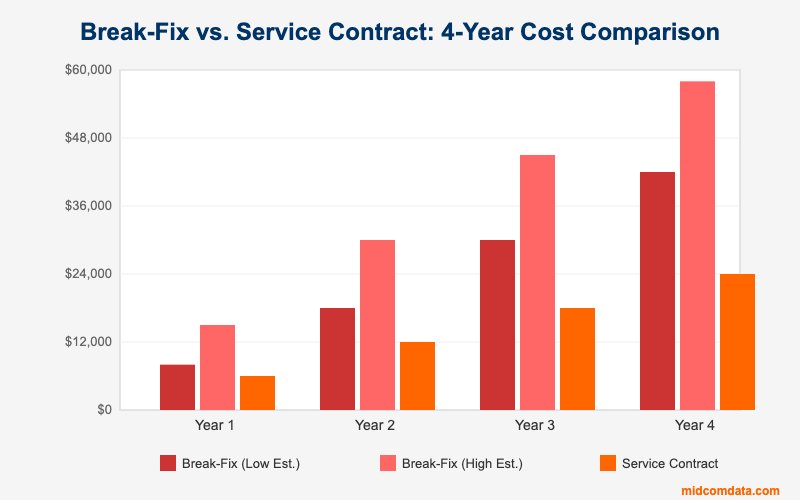
Break-fix costs can exceed service contract costs by 40–60% over four years.
Service Contract vs. Break-Fix: A Cost Comparison
Let’s look at real numbers. Below is a comparison based on typical printer models and annual maintenance patterns for a mid-sized warehouse operation:
Metric
Break-Fix (No Contract)
Service Contract
Printer
Zebra ZT411 (typical 4-year lifespan)
Annual Contract Cost
$0
$1,200–$1,800
Typical Annual Repairs
1–2 incidents
Included (unlimited)
Cost Per Unplanned Repair
$800–$2,500 (parts + labor + rush fees)
$0
Total 4-Year Cost (break-fix)
$3,200–$10,000
$4,800–$7,200
Total 4-Year Cost (high-failure)
$8,000–$15,000+
$4,800–$7,200
Unplanned Downtime Risk
High (5–15 days/year)
Low (<2 days/year)
The table shows why service contracts appeal to risk-averse operations: your cost is predictable and capped.
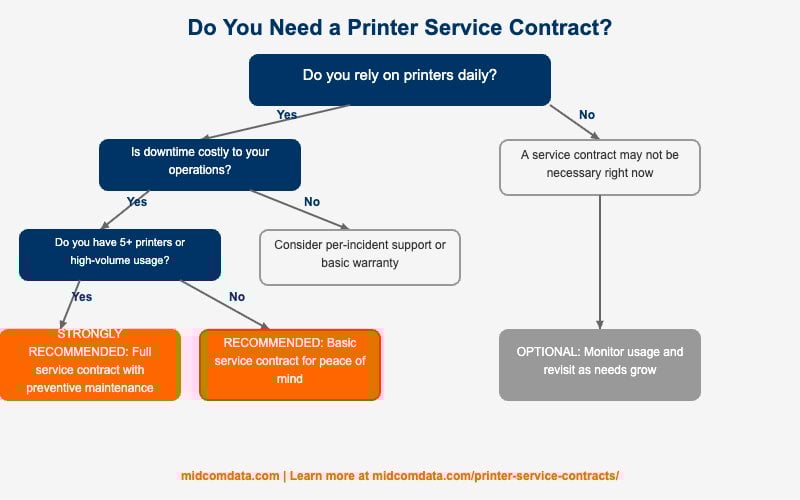
Use this flowchart to determine if a printer service contract is right for your business.
When a Service Contract Makes the Most Sense
Your Printer Is Revenue-Critical
If your operation ships hundreds of packages daily and labels are the first step in your fulfillment pipeline, a printer failure isn’t a nuisance—it’s a business threat. Thermal printers like the Honeywell PD45 or Zebra ZT610 handle the highest throughput in warehouse environments, and if yours is one of these high-volume models, a service contract’s predictable cost is cheap insurance against lost revenue.
You Lack In-House Technical Support
If your team doesn’t include someone certified in printer maintenance and troubleshooting, break-fix becomes riskier. A service contract includes rapid technician dispatch, often with on-site printer repair within 24 hours.
Your Printer Is Older or a Mixed-Model Fleet
Printers beyond their first 3 years of service fail more frequently. A service contract locks in labor rates and prioritizes parts sourcing, protecting you from the “vintage printer premium” that dealers apply to harder-to-find equipment.
You Want Proactive Maintenance
Premium service contracts include preventive maintenance visits—quarterly or semi-annual check-ups where technicians clean printheads, calibrate sensors, and replace wear items before they fail. Proactive maintenance reduces failure rates by 30–50% and extends printer lifespan.
When Break-Fix Might Be the Right Choice
You Have Budget Flexibility and Time Tolerance
If your warehouse can absorb a 3–5 day printer outage without significant revenue impact, break-fix removes your need to pay upfront. This works best for smaller operations with a single low-volume printer.
Your Printer Is Nearing End-of-Life
If your Zebra thermal printer is 5+ years old and functioning, a service contract may be poor value. Consider the thermal label printer buyback program to recoup some value while funding an upgrade.
What’s Included in a Typical Service Contract?
A full-service contract from a provider like MIDCOM Data Technologies typically includes:
Parts and labor coverage: All repairs and components covered
Priority response times: Technician dispatch within 4–24 hours
Preventive maintenance visits: Scheduled check-ups and calibration
24/7 support line: Technical phone support around the clock
No surprise costs: Repairs, diagnostics, and parts all included
FAQ
How much does a typical printer service contract cost?
For mid-range thermal printers like the Zebra ZT411 or Honeywell PD45, expect $1,200–$1,800 per year for comprehensive coverage including parts, labor, and preventive maintenance. The cost often breaks down to 8–12% of the printer’s original purchase price per year.
Is a service contract the same as the manufacturer’s warranty?
No. A manufacturer’s warranty covers defects for the first 1–3 years at no cost. A service contract extends coverage beyond the warranty period, includes planned maintenance, and guarantees rapid technician response.
Can I switch service contract providers?
Yes. You’re not locked to the original retailer or manufacturer. Printer protection plans from independent providers like MIDCOM Data Technologies often offer more flexibility than manufacturer plans.
What if my printer fails immediately after the contract starts?
A legitimate service contract covers failures from day one. There’s no waiting period. If a vendor tells you there’s a 30–90 day exclusion period, that’s a red flag.
Is it cheaper to just keep an extra printer in inventory?
Keeping a backup Zebra ZT610 costs $3,000–$5,000 upfront, plus ongoing maintenance and storage. Over a 4-year cycle, that’s more expensive than a service contract for most SMBs.
The Bottom Line
A printer service contract is worth it if your operation depends on consistent uptime, lacks in-house technical expertise, or runs equipment beyond the manufacturer warranty. For break-fix to make sense, you need genuine budget flexibility, tolerance for multi-day outages, and either a brand-new printer or older equipment you’re planning to retire soon.
If you operate thermal printers in a warehouse or logistics environment, talk to the experts at MIDCOM Data Technologies about whether a service contract aligns with your uptime needs and budget. With 40+ years of experience and 3,000+ technicians across the U.S. and Canada, we can help you compare options and find a plan that keeps your printers running and your shipments moving.