
Printer Repair VS Buying New
Total Cost of Ownership: Buying New Printers vs. Repairing What You Have
The Real Cost of Your Thermal Printer Fleet
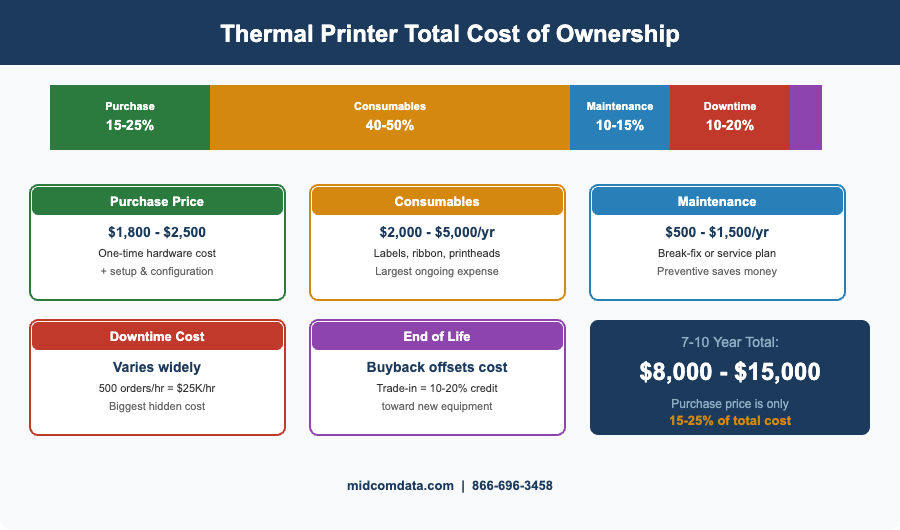
Total cost of ownership (TCO) for thermal printers goes well beyond the purchase price on the invoice. A $2,500 industrial printer can cost $8,000 or more over its lifetime once you factor in printheads, consumables, downtime, and service calls. Knowing where that money goes, and where you can control it, is what separates a good equipment decision from an expensive one. MIDCOM Data Technologies works with operations across the U.S. and Canada running fleets of five printers to five hundred. The repair-vs.-replace question comes up constantly, and the answer is almost never obvious without running the actual numbers.
Breaking Down Total Cost of Ownership
TCO for a thermal printer has five main components. Most operations only track the first one, which is why they make expensive decisions based on incomplete information.
1. Acquisition Cost
This is the sticker price, the easiest number to see and the one that gets the most attention. A new Zebra ZT411, one of the most widely deployed industrial printers in warehouse environments, runs approximately $1,800 to $2,500 depending on configuration (resolution, connectivity options, cutter or peeler accessories). A comparable Honeywell PX45 or SATO CL4NX Plus falls in a similar range. Acquisition cost also includes initial setup: configuration, label format programming, network integration, and any mounting hardware. For a fleet deployment, these soft costs add 5–10% on top of the hardware price. Refurbished printers from reputable suppliers can cut acquisition cost by 30–50% while delivering comparable performance, especially for environments where the latest features are not critical.
2. Consumables
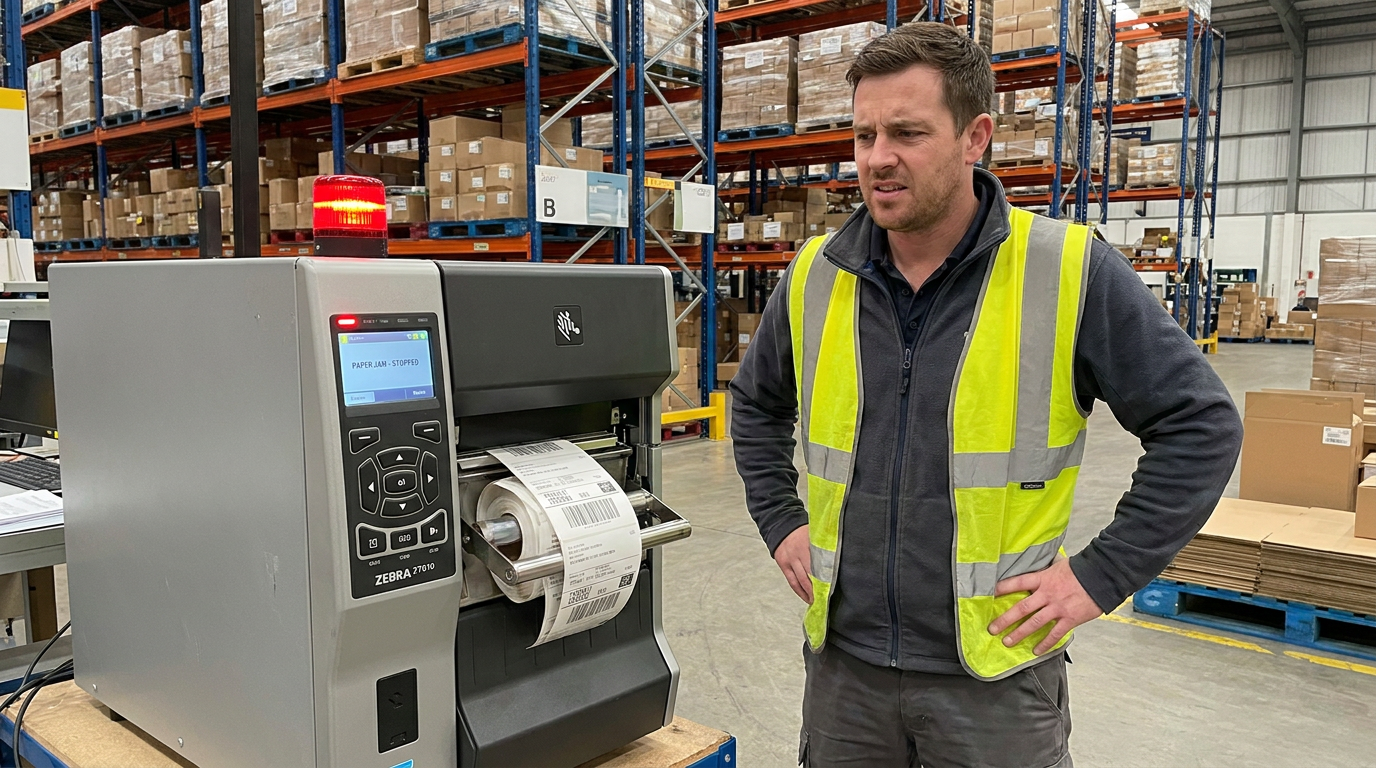
Consumables are the largest ongoing expense for most thermal printer operations, and they dwarf the original hardware cost over a printer’s lifetime. Consumables include label stock, thermal transfer ribbon (if applicable), and printheads. A standard 4×6 direct thermal shipping label costs roughly $0.02 to $0.04 per label depending on volume and supplier. An operation printing 2,000 labels per day spends $40 to $80 per day on labels alone — $10,000 to $20,000 per year per printer just in label stock. Thermal transfer ribbon adds another $1,500 to $3,000 per year for a moderate-volume printer. Printheads are the big-ticket consumable. A replacement printhead for a Zebra ZT411 runs $300 to $500. At typical print volumes, you will replace it every 12 to 24 months. Over a printer’s 7-to-10-year lifespan, printhead replacements alone add $1,500 to $4,000 to the total cost. Choosing the right consumables matters more than most people realize. Cheap, off-brand labels with inconsistent adhesive cause more jams, leave more residue on the printhead, and shorten its life. Quality consumables from a reputable supplier cost slightly more per unit but save money over time because you waste less and replace printheads less often.
3. Maintenance and Repair
Every thermal printer needs maintenance. The question is whether you pay for it in planned service visits or in unplanned emergency calls and lost production. A typical break-fix service call (a technician shows up to diagnose and repair a problem) costs $250 to $500 for the visit plus parts. If the printer is down during a critical shift and you need priority response, expect to pay a premium. Two or three unplanned service calls per year add $750 to $1,500 annually, and that does not account for the production time lost while waiting for the repair. A printer service contract (also called a protection plan) bundles preventive maintenance visits, priority repair response, and parts coverage into a fixed monthly or annual fee. For most operations running critical printers, this is the more cost-effective path. You trade unpredictable break-fix expenses for a known monthly cost, and you get preventive visits that catch problems before they cause downtime.
4. Downtime
Downtime is the cost that rarely shows up on a spreadsheet but hits the hardest. When a thermal printer fails on a shipping line, the impact goes beyond the repair bill. It is the cost of everything that does not ship while the printer is down. A distribution center shipping 500 orders per hour at an average order value of $50 generates $25,000 per hour in throughput. If one printer failure takes a packing line offline for three hours, the disruption cost in delayed shipments, overtime labor, and potential customer penalties easily reaches thousands of dollars. That single incident can exceed the cost of a year’s worth of preventive maintenance. Downtime costs are the strongest arguments for both proactive maintenance and having spare printers staged and configured. MIDCOM recommends keeping at least one backup printer for every 10 production units, pre-loaded with your label formats and ready to swap in within minutes.
5. End-of-Life and Disposal
When a printer reaches the end of its life, it still has value, or at least it can.MIDCOM’s thermal printer buyback program purchases used equipment and applies that credit toward new hardware. This is not a trivial amount: depending on the model, age, and condition, buyback credits can offset 10–20% of a new printer’s cost. Without a buyback or trade-in program, old printers become e-waste that costs money to dispose of properly. Factor disposal costs into your TCO calculation, and factor buyback credits in as a cost offset when planning replacements.
Repair vs. Replace: Running the Numbers
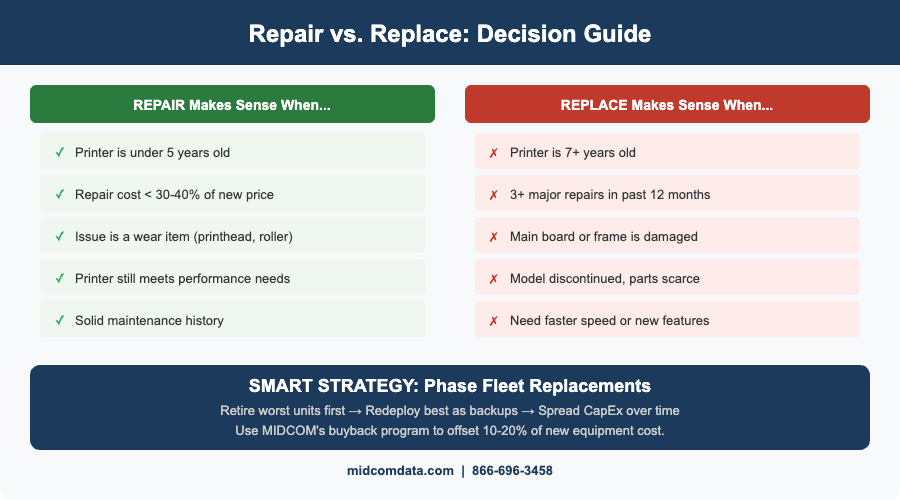
With those cost components in mind, here is a practical framework for deciding whether a specific printer should be repaired or replaced.
Repair Makes Sense When:
The printer is less than 5 years old and has a solid maintenance history. The repair cost is less than 30–40% of a comparable new printer. The issue is a known wear item (printhead, platen roller, ribbon motor) rather than a main board or structural failure. And the printer still meets your performance requirements — print speed, resolution, and connectivity are adequate for your current workflows. A well-maintained Zebra ZT410 that needs a new platen roller and printhead (roughly $600 to $800 in parts and labor) has plenty of productive years left. That repair costs a fraction of a $2,500 replacement and keeps a proven machine running.
Replace Makes Sense When:
The printer is more than 7 years old and has had three or more major repairs in the past year. The main logic board or structural frame is damaged. The manufacturer has discontinued the model and parts availability is declining. Or your operation has outgrown the printer’s capabilities and you need faster print speeds, higher resolution, or connectivity options (like Wi-Fi 6) that the old model does not support. When replacing, look at the full fleet picture. If half your printers are the same aging model, a phased replacement plan (retiring the worst units first and redeploying the best as backups) spreads the capital expense over time while immediately improving reliability on your most critical lines.
How Service Contracts Change the Math
A service contract changes the TCO math by converting variable repair costs into a fixed expense and adding preventive maintenance that extends equipment lifespan. Consider a fleet of 20 printers without a service contract. At an average of 1.5 unplanned service calls per printer per year at $400 each, the annual break-fix budget is $12,000, and that is an average year. One bad quarter with multiple failures can blow that number up. A service contract covering the same 20 printers typically costs less per unit than the average break-fix spend, and it includes preventive maintenance visits that reduce the number of unplanned failures. The net effect is lower total maintenance cost, more predictable budgeting, and longer equipment lifespan because problems get caught early. MIDCOM’s printer protection plans cover on-site service, parts, and preventive maintenance with response-time guarantees. For operations where printer uptime is directly tied to shipping revenue, the numbers usually favor the contract.
Frequently Asked Questions
What is the total cost of ownership for a thermal printer?
Total cost of ownership for an industrial thermal printer typically ranges from $8,000 to $15,000 over a 7-to-10-year lifespan. This includes the purchase price ($1,800–$2,500), consumables ($2,000–$5,000/year in labels, ribbon, and printheads), maintenance and repair ($500–$1,500/year), and downtime costs which vary by operation. The purchase price represents only 15–25% of the total lifetime cost.
When should I replace a thermal printer instead of repairing it?
Replace rather than repair when the repair cost exceeds 40–50% of a new printer’s price, the printer has needed three or more major repairs in the past 12 months, the manufacturer has discontinued the model (making parts scarce), or the printer can no longer meet your speed, resolution, or connectivity needs. MIDCOM’s technicians can provide an honest repair-vs.-replace recommendation based on your specific situation.
How much does thermal printer downtime really cost?
Downtime cost depends on your operation, but it is almost always more than people expect. A shipping line processing 500 orders per hour loses thousands of dollars for every hour a printer is offline — not just in direct costs, but in delayed shipments, overtime labor, and customer penalties. This is why preventive maintenance and having backup printers configured and ready are cost-effective investments.
Are printer service contracts worth the cost?
For operations running critical printers where downtime directly impacts revenue, service contracts are almost always worth it. They convert unpredictable break-fix expenses into a fixed monthly cost, include preventive maintenance that catches problems early, and guarantee response times. The breakeven point is typically reached after just one or two avoided emergency service calls per year.
How can I reduce thermal printer consumable costs?
Use quality label stock and ribbon from reputable suppliers — cheap media causes more jams, wears out printheads faster, and wastes more material per roll. Optimize your darkness/heat settings to the minimum level that produces scannable output, which extends printhead life. Buy consumables in bulk when possible, and review your label sizes to ensure you are not using oversized labels for content that fits on a smaller format.
Make Data-Driven Equipment Decisions
The repair-vs.-replace question does not have to be a guess. Track your per-printer costs (consumables, service calls, downtime incidents) and compare them against the cost of new equipment amortized over its expected lifespan. When the numbers say repair, MIDCOM’s on-site technicians keep your equipment running well. When the numbers say replace, MIDCOM’s printer catalog and buyback program make the switch easier. Call 866-696-3458 or contact us online to get a fleet assessment started.
Contact MIDCOM Data Technologies at 866-696-3458.