
Direct Thermal vs Thermal Transfer
Direct Thermal vs. Thermal Transfer: Which Print Method Fits Your Operation?
Direct thermal vs. thermal transfer printing
Direct thermal and thermal transfer are the two print methods used in industrial label printers, and picking the wrong one costs you money on every label you print. Direct thermal uses heat-sensitive media that darkens when the printhead applies heat — no ribbon required. Thermal transfer presses ink from a ribbon onto the label surface, producing a more durable image. The right choice depends on how long your labels need to last, what environment they’ll live in, and what you’re spending per label.
How direct thermal printing works
A direct thermal printer uses a printhead with tiny heating elements that selectively activate against chemically treated label stock. Where the elements fire, the label surface turns black (or another color, depending on the media chemistry). There’s no ink, toner, or ribbon involved — the label itself is the imaging medium.
This makes direct thermal printers simpler to operate. You load a roll of labels, and you’re printing. No ribbon to thread, no ribbon wrinkle to troubleshoot, and one less consumable to reorder. The Zebra ZD421d, for example, is a popular desktop direct thermal printer that handles up to 300 labels per day in shipping and receiving departments without ribbon changes.
The trade-off is durability. Direct thermal labels are sensitive to heat, sunlight, and friction. Leave a direct thermal shipping label on a pallet sitting in a sunny loading dock for two weeks, and the barcode may fade enough to cause scan failures. In a climate-controlled warehouse where labels last days or weeks, that’s rarely a problem. On a product that sits on a retail shelf for six months, it’s a dealbreaker.
How thermal transfer printing works
Thermal transfer printers use the same type of heated printhead, but instead of reacting with the label surface directly, the heat melts ink from a ribbon onto the label. The ribbon sits between the printhead and the label stock, and as both advance through the printer, the image transfers from ribbon to label.
The printed image bonds to the label surface rather than sitting in a reactive coating. Thermal transfer labels resist heat, UV exposure, moisture, and chemical contact far better than direct thermal. A thermal transfer label printed on synthetic stock with a resin ribbon can survive outdoor exposure, chemical baths, and autoclave sterilization — conditions that would destroy a direct thermal label in hours.
The added durability comes with added complexity. You need to stock ribbon alongside label rolls, thread the ribbon correctly during media changes, and match the ribbon type to your label material. A Zebra ZT411 running thermal transfer, for instance, requires you to select between wax, wax-resin, or resin ribbons depending on what you’re labeling.
Label durability: the deciding factor
The simplest way to choose between the two methods is to ask: how long does this label need to be readable?
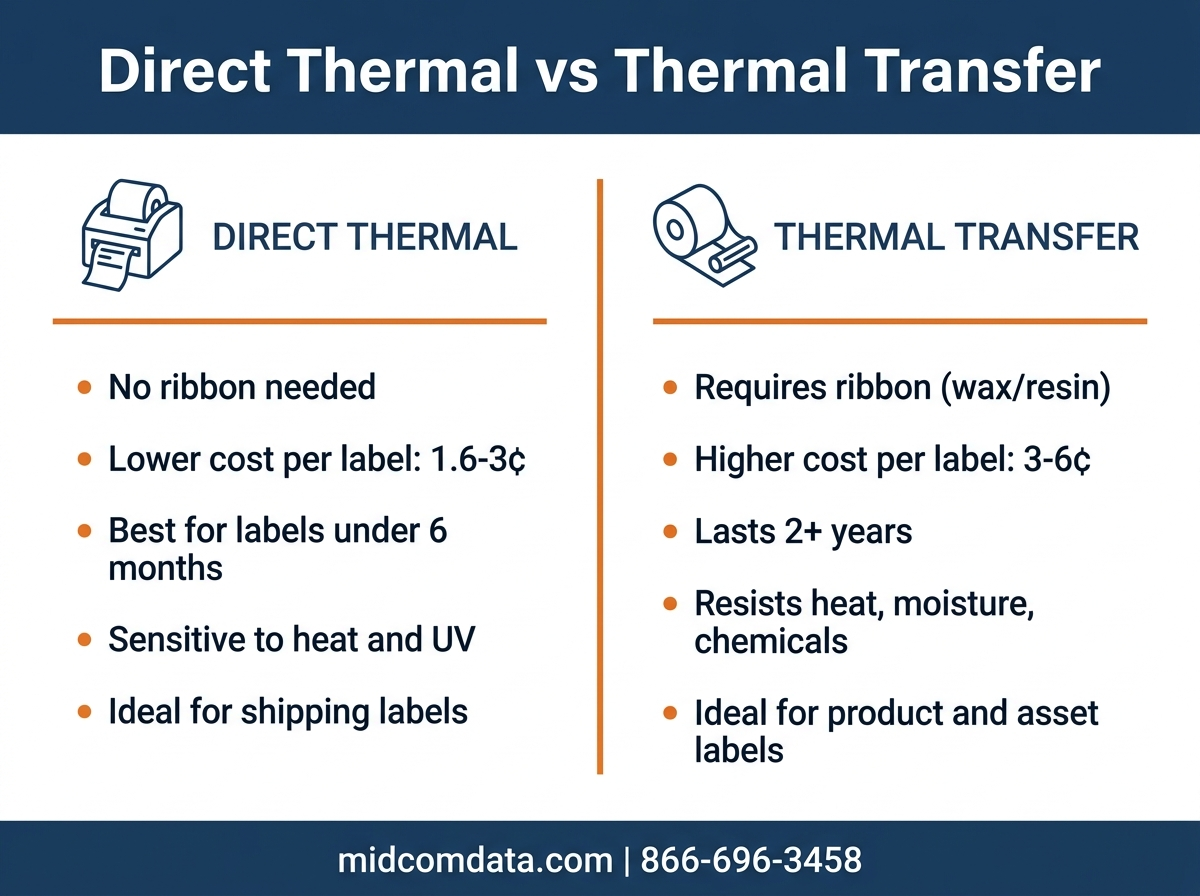
Direct thermal works well when labels last less than 6 months and stay in controlled environments. Shipping labels, packing slips, receipt paper, visitor badges, and short-term inventory tags are all strong direct thermal use cases. If the label does its job and gets thrown away within days or weeks, there’s no reason to pay for ribbon.
Thermal transfer is the right call when labels need to survive longer than 6 months, endure harsh conditions, or meet regulatory requirements. Product identification labels, asset tags, chemical drum labels, outdoor signage, and healthcare specimen labels all demand thermal transfer. The label has to remain scannable and legible for months or years, sometimes in freezing, wet, or chemically aggressive environments.
Durability comparison by environment
In a temperature-controlled warehouse at 68°F with fluorescent lighting, a direct thermal label stays scannable for 6 to 12 months. A thermal transfer label in the same environment lasts 2 years or more. Move those labels to a loading dock that hits 100°F in summer sun, and the direct thermal label starts degrading in 2 to 4 weeks. The thermal transfer label printed with wax-resin ribbon is unaffected.
For cold chain applications — pharmaceutical distribution, frozen food logistics — thermal transfer on synthetic label stock is the only reliable option. Direct thermal labels turn completely black when exposed to heat during defrost cycles, making them unreadable.
Cost per label: running the numbers
Direct thermal printing has a lower cost per label when you only count consumables. You’re buying label stock and nothing else. A standard roll of 4×6 direct thermal shipping labels (500 per roll) runs $8 to $15 depending on quantity and supplier. That works out to roughly 1.6 to 3 cents per label.
Thermal transfer adds ribbon cost on top of label stock. The same 4×6 label in thermal transfer stock costs about the same for the labels, but you add $15 to $40 per ribbon roll depending on ribbon type (wax is cheapest, resin is most expensive). A standard wax ribbon prints roughly 1,500 to 2,500 labels. Factoring in ribbon, your per-label cost lands at 3 to 6 cents — roughly double the direct thermal cost.
But that math only tells half the story. If your direct thermal labels fade and cause scan failures, you’re reprinting labels, re-processing shipments, and eating chargebacks from retailers. One missed scan on an Amazon-bound shipment can trigger penalties that wipe out a year’s worth of ribbon savings.
Printer hardware differences
Most industrial thermal printers from Zebra, Honeywell, and SATO support both print methods. The Zebra ZT411, ZT610, and ZT231 all handle direct thermal and thermal transfer — you just load or remove the ribbon. Some desktop models are direct-thermal-only (like the Zebra ZD421d), so check the spec sheet before purchasing if you think you might need thermal transfer later.
Thermal transfer printing is slightly harder on printheads. The ribbon adds friction, and if ribbon tension isn’t set correctly, it can cause uneven wear. Printhead life on a thermal transfer printer typically runs 1 to 2 million linear inches versus 2 to 4 million on a direct thermal unit doing the same volume — though actual lifespan varies by print darkness settings, media type, and how well you maintain the printer.
If your thermal printers are reaching end of life and you’re evaluating replacements, MIDCOM Data Technologies can help you spec the right model for your print method and volume. Call 866-696-3458 or request a quote online.
Common mistakes when choosing a print method
Using direct thermal for long-life labels to save on ribbon
This is the most common mistake. The $0.02 per label you save on ribbon gets eaten by reprints, scan failures, and compliance issues when labels degrade. If your labels need to survive more than 90 days in anything other than a climate-controlled environment, use thermal transfer.
Using thermal transfer for shipping labels that get scanned once
If you’re printing thousands of outbound shipping labels per day that get scanned at the dock and discarded after delivery, you’re wasting money on ribbon. Direct thermal handles this application perfectly and cuts your consumable cost in half.
Mismatching ribbon type to label material
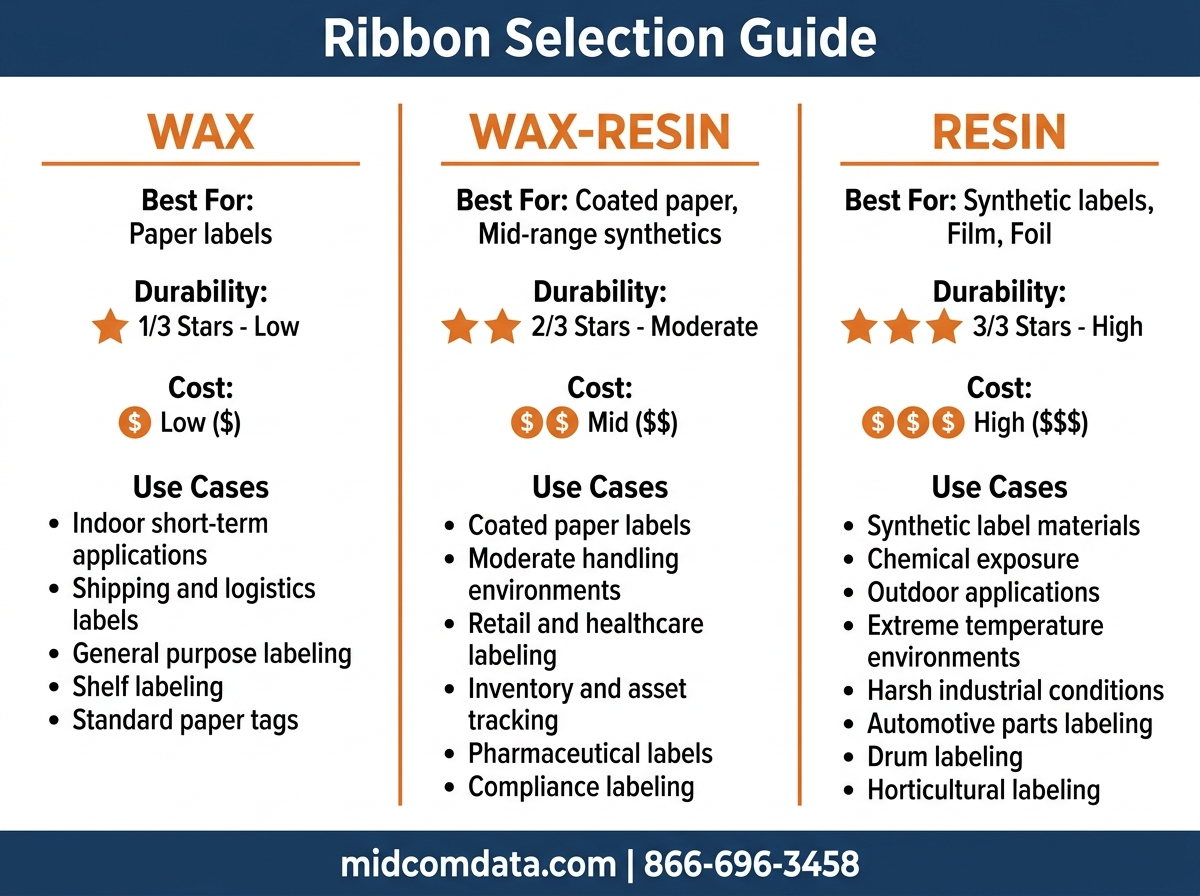
Wax ribbon on a synthetic label won’t adhere properly — the image rubs off with light friction. Resin ribbon on standard paper labels works but costs three times more than the wax ribbon that would do the job just as well. Match the ribbon to the face stock: wax for paper, wax-resin for coated paper and light synthetics, resin for polyester and polypropylene.
Which method does your operation need?
For most warehouse and distribution operations, the answer is both. Shipping and receiving labels are direct thermal — high volume, short life, no need for ribbon. Asset tags, product labels, and compliance labels are thermal transfer — lower volume, long life, durability matters.
That’s why printers like the Zebra ZT411 are so popular in mixed operations. You can run direct thermal for one job and load a ribbon for the next without swapping hardware. If you’re running enough volume to justify dedicated printers, a direct thermal unit at the pack station and a thermal transfer unit at the compliance labeling station keeps things simple.
Need help figuring out the right setup? MIDCOM Data Technologies has been helping warehouses and distribution centers get their print infrastructure right for over 40 years. Our technicians can audit your labeling workflow and recommend the right combination of print methods, media, and ribbons for your operation. Get in touch or call 866-696-3458.
Frequently asked questions
Can one printer do both direct thermal and thermal transfer?
Yes. Most industrial thermal printers from Zebra, Honeywell, and SATO support both methods. You switch between them by loading or removing the ribbon. Some desktop models are direct-thermal-only, so verify the spec sheet before purchasing.
Which print method is cheaper per label?
Direct thermal costs roughly 1.6 to 3 cents per 4×6 label (media only). Thermal transfer runs 3 to 6 cents per label when you factor in ribbon. Direct thermal saves money when labels are short-lived; thermal transfer saves money when you account for reprints and failures caused by degraded labels.
How long do direct thermal labels last?
In a climate-controlled warehouse, 6 to 12 months. In direct sunlight or temperatures above 140°F, they can degrade in days. For any application requiring more than 90 days of readability in uncontrolled conditions, use thermal transfer.
What ribbon type should I use for thermal transfer?
Wax ribbon for standard paper labels (cheapest, good for short to mid-term use). Wax-resin for coated paper and light synthetic labels (more smear-resistant). Resin for polyester and polypropylene synthetics (most durable, withstands chemicals and outdoor exposure).
Does thermal transfer wear out printheads faster?
Thermal transfer does add friction from the ribbon, which can reduce printhead life compared to direct thermal at the same volume. Typical printhead life is 1 to 2 million linear inches for thermal transfer versus 2 to 4 million for direct thermal. Proper preventive maintenance extends life for both methods.