
Printer Downtime Cost In The Warehouse
The True Cost of Printer Downtime in a Warehouse
What an hour of printer downtime actually costs
When a label printer goes down on a shipping line, the cost isn’t the repair bill — it’s the idle labor, the missed carrier cutoff, and the orders that ship a day late. A pack station running 400 labels an hour with three people on it burns roughly $90 in wages per idle hour before you count a single late shipment penalty. Most operations never calculate this number, which is exactly why printer maintenance keeps losing budget arguments to things that feel more urgent.
The four costs of a printer going down
Idle labor
This is the easiest number to calculate and usually the largest. Count everyone who stops working when the printer stops. On a pack line, that’s the packers, and often the picker feeding them once the conveyor backs up.
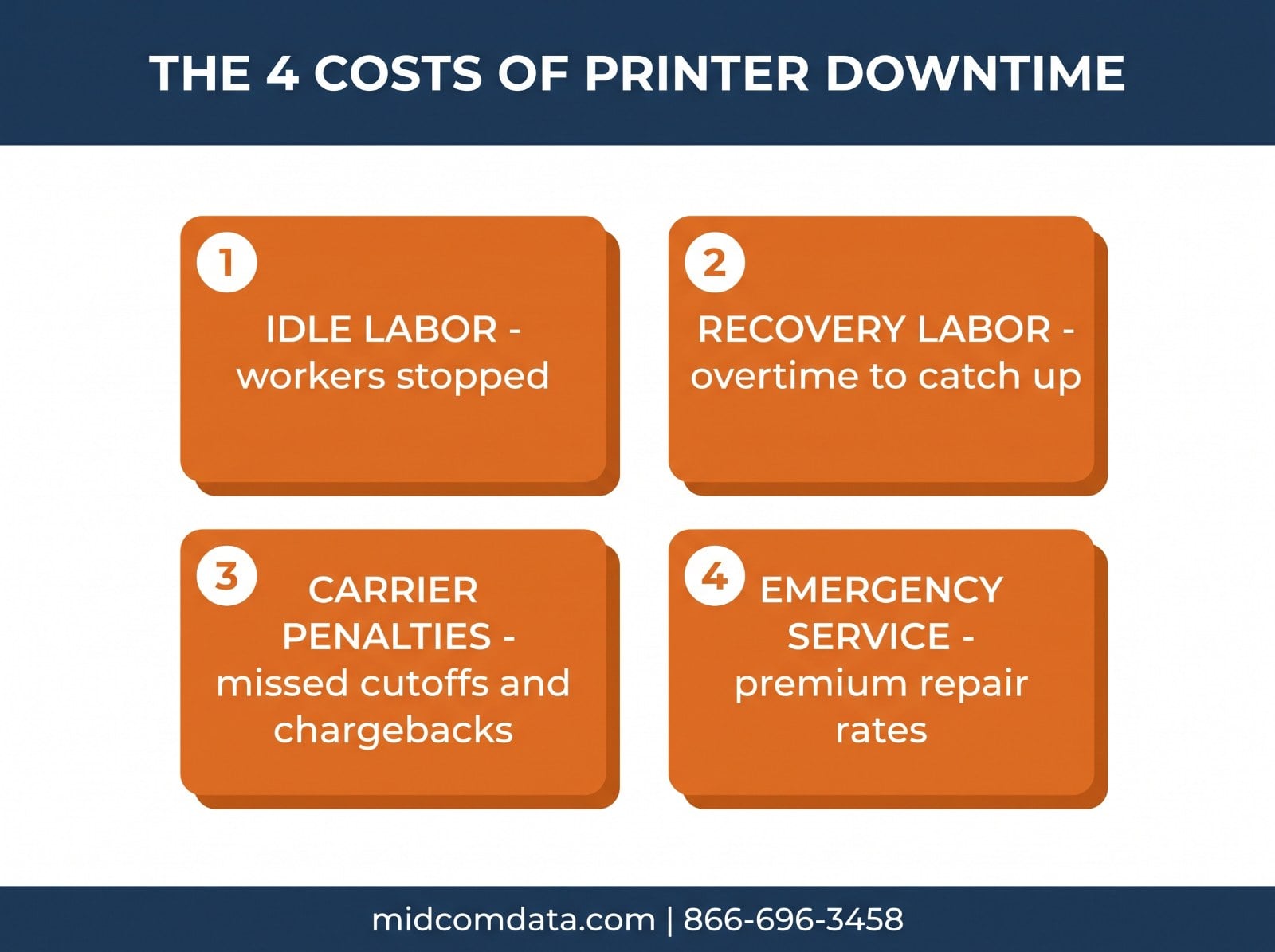
Take a fully loaded labor rate — wages plus payroll tax and benefits, typically 1.25 to 1.4 times the hourly wage. Three packers at $22/hour fully loaded is $66 per hour. Add the supervisor who spends 30 minutes troubleshooting instead of managing, and a picker who idles once the line stalls, and you’re closer to $100 for that hour.
Recovery labor
Work doesn’t just resume — it has to catch up. Orders that queued during the outage still need to ship, which usually means overtime or a compressed second shift. Overtime at 1.5x on four hours of backlog across three people adds about $400.
There’s also rework: labels printed during the failure window that came out faded or misaligned before anyone noticed. Those cartons have to be relabeled, and if any already shipped, you’re dealing with a receiving exception at the other end.
Carrier and customer penalties
This is where downtime gets expensive fast. Miss a UPS or FedEx pickup and every order on the dock ships a day late. If you’re shipping to a major retailer with an on-time delivery requirement, late shipments trigger chargebacks. Walmart’s OTIF program and Amazon’s vendor performance metrics both assess fees for late or short shipments, and those penalties are calculated as a percentage of the cost of goods on the affected order — not a flat fee.
A single missed carrier cutoff affecting 200 orders can generate more in chargebacks than a year of preventive maintenance costs.
Emergency service premium
Calling for emergency repair without a contract means paying premium rates, and during peak season you’re competing with everyone else for the same technicians. Emergency on-site service typically runs 1.5 to 2 times the contracted rate, plus expedited parts shipping. A printhead that costs $180 with next-day ground becomes $180 plus $85 overnight freight when you need it tomorrow morning.
Running the numbers for your operation
Downtime cost per hour = (idle headcount × fully loaded hourly rate) + (recovery hours × overtime rate) + (probability of missing cutoff × penalty exposure) + prorated emergency service cost
A worked example. A distribution center runs one industrial printer feeding a pack line with four people. Fully loaded rate is $26/hour. The printer fails at 1pm; the carrier cutoff is 4pm.
Idle labor for two hours while a technician is located and arrives: 4 × $26 × 2 = $208. Recovery overtime that evening, three people for three hours at 1.5x: 3 × $39 × 3 = $351. The 4pm cutoff is missed, so 180 orders ship next day; at an average $4 per order in expedite fees and chargeback exposure, that’s $720. Emergency service call: $450 versus $240 under contract, so $210 in premium.
Total for one afternoon: about $1,489. A preventive maintenance visit for that printer costs a fraction of that, and a backup printer on the shelf costs less than a single incident.
What the number looks like across operation sizes
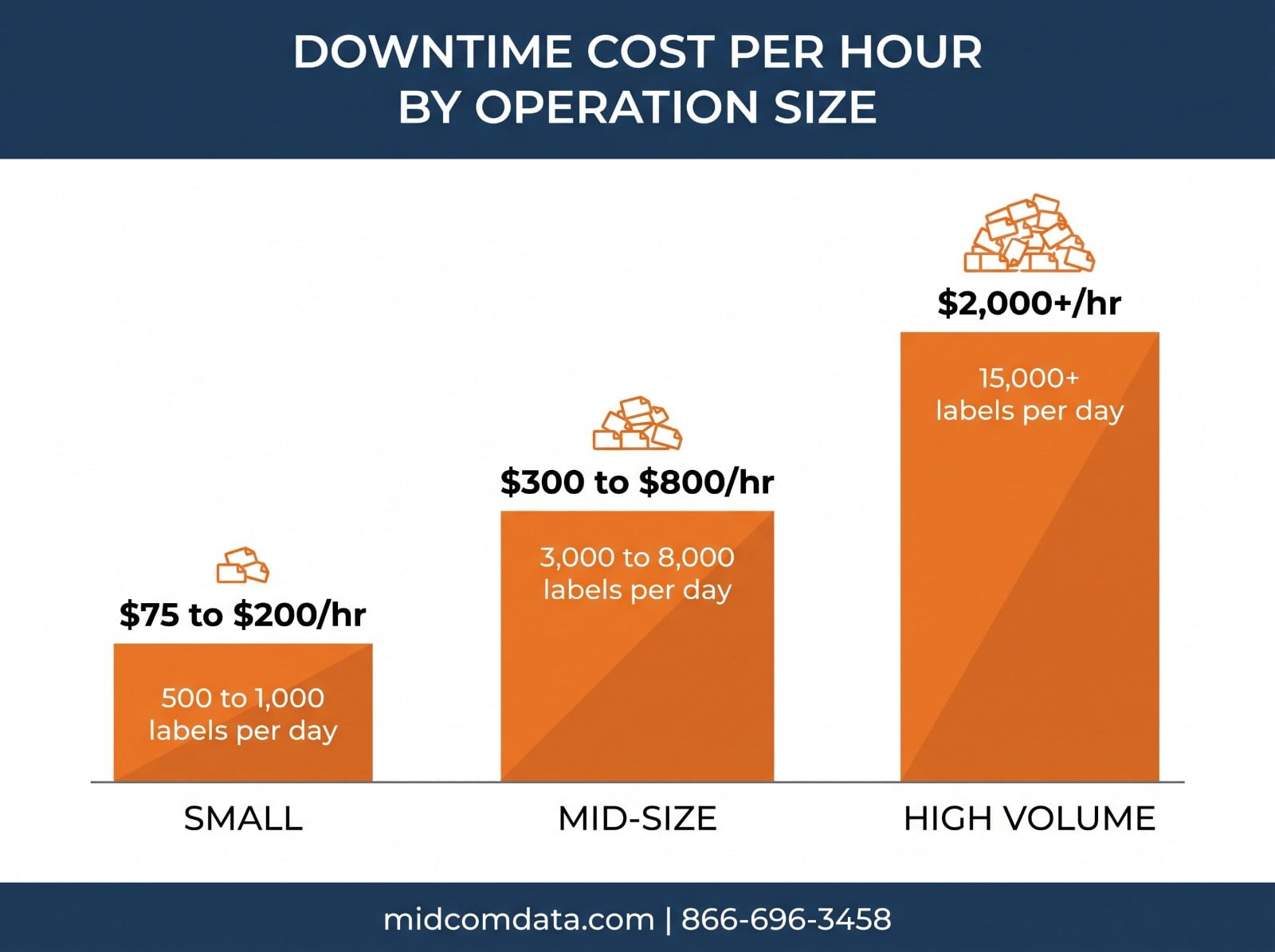
Small operations running 500 to 1,000 labels a day with one or two people at the pack station typically land between $75 and $200 per hour of downtime. Mid-size operations with multiple pack stations and 3,000 to 8,000 labels daily run $300 to $800 per hour. High-volume distribution centers printing 15,000-plus labels a day, where a printer outage can stall an entire zone, routinely exceed $2,000 per hour once chargeback exposure is included.
Where printer failures actually come from
Knowing your hourly cost only helps if you also know what’s likely to cause the outage. In thermal printing, most unplanned downtime traces back to a short list.
Printhead failure is the most common hard failure. Printheads are consumable — rated for 1 to 4 million linear inches depending on print method and darkness settings — and they fail progressively, producing faded or streaky labels before they quit entirely. Which means most printhead failures are predictable if anyone is watching print quality.
Media path problems cause more incidents but shorter ones. Adhesive buildup on sensors and guides causes misfeeds and calibration errors. This is a cleaning issue, and it’s the failure mode most easily prevented.
Platen roller wear produces inconsistent print density and tracking problems that get misdiagnosed as printhead failure. Rollers glaze and develop flat spots over time.
Connectivity failures — a dropped Wi-Fi association, an IP conflict after a network change, a driver update that breaks the print queue — take down printing without anything being mechanically wrong. These are frustrating because the printer looks fine.
MIDCOM Data Technologies provides on-site printer repair across the U.S. and Canada, with technicians who diagnose and fix all of the above. Our preventive maintenance schedule covers the cleaning and inspection intervals that prevent most of these failures.
Reducing your downtime exposure
Preventive maintenance
Scheduled cleaning and calibration catches wear before it becomes failure. A technician who inspects a printhead at 1.8 million inches can tell you to order a replacement now rather than have it die mid-shift. Quarterly professional service on critical printers, plus daily operator-level printhead cleaning, eliminates the majority of preventable outages.
Spare parts on the shelf
For any printer where a failure stops a line, keep a spare printhead and platen roller on site. A printhead sitting in a drawer costs $150 to $400 depending on model and resolution. Compare that to the downtime numbers above and the decision makes itself. MIDCOM stocks printheads and spare parts for all major brands.
Redundancy at critical points
Single points of failure are where most of the risk sits. One printer feeding one line means that line’s uptime equals that printer’s uptime. Options, roughly in order of cost: keep a configured spare printer on a cart that can be wheeled in and plugged into the same network drop; run two printers at high-volume stations with jobs split between them, so a failure halves throughput instead of stopping it; or maintain a service contract with a loaner program so a replacement arrives while yours is repaired.
Service contracts as downtime insurance
A service contract converts unpredictable emergency costs into a fixed annual number, and more importantly it buys you a guaranteed response time. During peak season, the difference between a 4-hour response and a 48-hour response is the difference between an inconvenience and a shipping crisis.
MIDCOM’s printer protection plans include guaranteed response times, next-business-day on-site service options, and loaner equipment programs. Given the numbers above, the contract typically pays for itself the first time it prevents a missed carrier cutoff. Call 866-696-3458 or request a quote to see what coverage looks like for your equipment.
Making the budget case
If you’re trying to get maintenance or redundancy funded, lead with the hourly number rather than the equipment specs. “Our pack line costs $600 an hour when it’s down, and we had 14 hours of printer downtime last year” is an argument finance can act on. “We should service the printers more often” is not.
Track downtime incidents for a quarter — date, duration, cause, and what stopped. Four data points is usually enough to show a pattern, and it turns the conversation from an opinion about maintenance into a cost comparison. Most operations find their annual downtime cost is several times what full preventive coverage would have cost.
MIDCOM Data Technologies has been keeping warehouse and distribution equipment running since 1982, with over 3,000 technicians across the U.S. and Canada. Get in touch or call 866-696-3458 for a downtime risk assessment on your print infrastructure.
Frequently asked questions
How do I calculate printer downtime cost for my warehouse?
Add idle labor (headcount stopped × fully loaded hourly rate), recovery labor including overtime to clear the backlog, penalty exposure from missed carrier cutoffs or retailer chargebacks, and any emergency service premium above your normal rate. Most small operations land between $75 and $200 per hour; high-volume distribution centers can exceed $2,000.
What causes most thermal printer downtime?
Printhead wear is the most common hard failure, followed by media path issues from adhesive buildup on sensors and guides, platen roller wear, and connectivity problems. Printhead and roller wear are both progressive, which means regular inspection catches them before they cause an outage.
Is a printer service contract worth the cost?
It depends on your downtime cost per hour and how much a failure disrupts. If a printer outage stops a shipping line, a contract with a guaranteed response time and loaner equipment usually pays for itself the first time it prevents a missed carrier cutoff. For a low-volume printer whose failure is an inconvenience rather than a stoppage, break-fix service may be adequate.
How long does emergency printer repair take without a contract?
Without a service agreement you’re scheduled as availability allows, which commonly means 1 to 3 business days and longer during peak season when technicians are booked. Contract customers typically get same-day or next-business-day response depending on the coverage level.
Should I keep a backup printer on hand?
For any printer whose failure stops a production or shipping line, yes. A configured spare that can be swapped in within minutes eliminates the largest component of downtime cost. Refurbished units are a cost-effective way to add redundancy without paying new-equipment prices for a machine that mostly sits idle.