
RFID Solving Lost Merchandise In Retail Stores
How Is RFID Used to Find Lost Merchandise in Retail Stores?
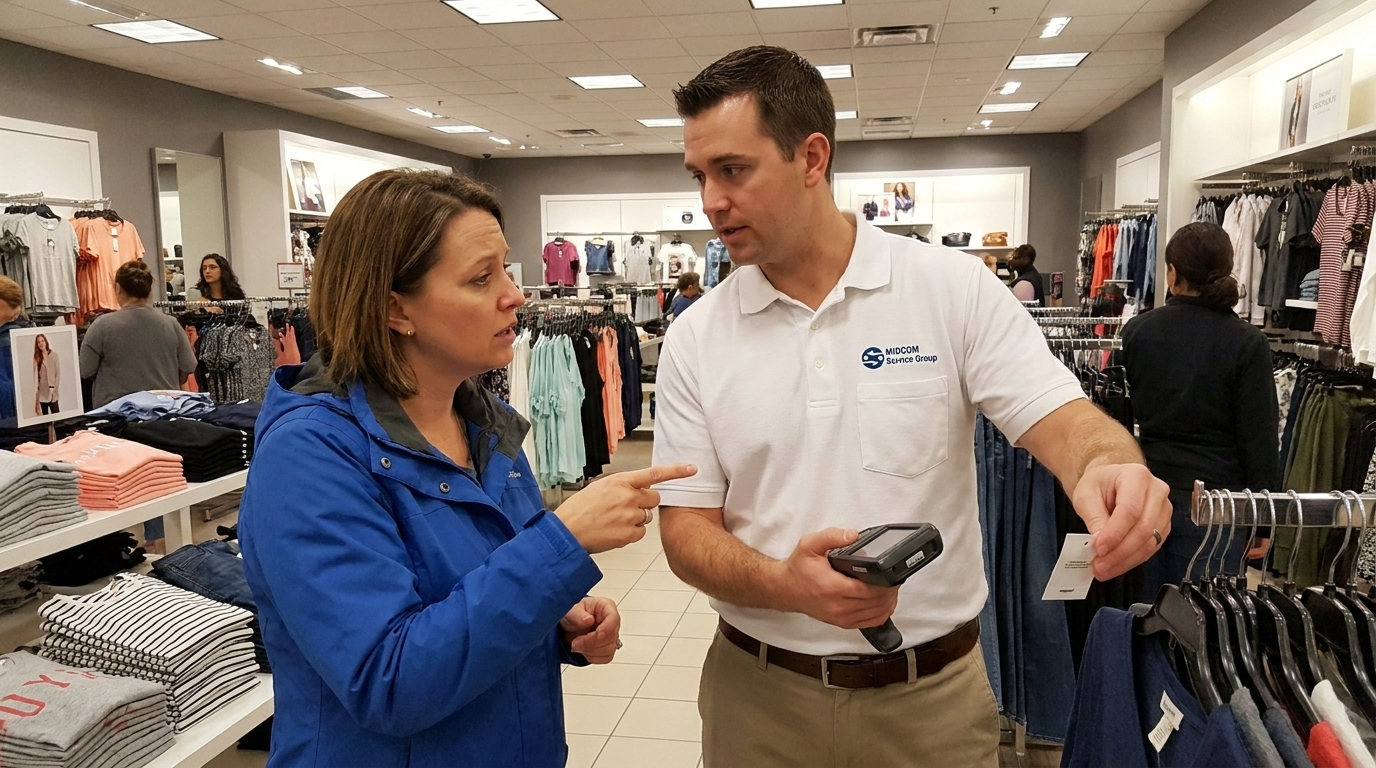
A customer asks for a shirt in a specific size. The inventory system shows one in stock, but the item is nowhere on the expected rack. It may have been returned to the wrong fixture, left in the stockroom, moved to another department, or removed from the store without the record being updated. For associates, finding that single item can become a time-consuming search.
RFID gives retailers a faster way to investigate these gaps. Each tagged item carries a unique digital identity that can be detected by RFID readers without direct line-of-sight scanning. Handheld readers can help associates narrow down a product’s location, while fixed readers and inventory software provide visibility into movement and stock status at monitored points across the store.
What Does “Lost Merchandise” Actually Mean in a Retail Store?
Missing merchandise does not always mean theft. An item may be on the wrong rack, left in the stockroom, or mixed with returns. Research on retail product misplacement shows that such errors can leave products recorded as available even when customers and staff cannot find them.
Inventory-record inaccuracies can also result from receiving, transfer, counting, or transaction errors. In other cases, the item may genuinely be lost through theft, damage, or another form of shrink.
RFID helps distinguish these situations. Handheld searches can locate misplaced stock, cycle counts can expose inaccurate records, and movement or exit data can indicate whether a tagged item has left a monitored area.
How RFID Turns a Missing Product Into a Searchable Item
The process starts with an RFID tag attached to the merchandise. At the item level, the tag carries an electronic identifier that distinguishes the individual product. GS1 describes retail RFID workflows in which item-level identifiers are captured at receiving, on the shop floor, at point of sale, and at exits, allowing inventory systems to build a more detailed record of merchandise availability and movement.
RFID readers use radio waves to detect compatible tags without requiring an associate to position each barcode directly in front of a scanner. This allows multiple tagged products to be read during a stock check and makes it practical to search an area for a particular item.
Suppose the system shows one pair of size-8 shoes in the store, but the selling location is empty. An associate can select the relevant SKU or EPC in the inventory application and use an RFID reader to search the stockroom and sales floor. Reader detections help narrow the search to areas where that tag can be found.
This item-level RFID visibility also improves inventory record quality. When repeated scans show that merchandise expected in a location is absent, the retailer has a specific discrepancy to investigate instead of relying on an on-hand count that may no longer reflect physical stock. GS1 also identifies RFID as useful for reducing situations where merchandise is recorded in stock but cannot be found on the shelf.
Locating Misplaced Merchandise With Handheld RFID Readers
Handheld RFID is especially useful when the retailer believes an item is still inside the store but does not know exactly where it has been placed. An associate can move through racks, shelves, return areas, and the stockroom while the reader detects tagged merchandise within range. This removes much of the shelf-by-shelf checking required when the only available identifier is a visible barcode.
Consider a clothing store where a customer wants a jacket in a specific size and color. The system shows one unit available, but it is missing from its normal rack. The associate can search nearby fixtures, fitting-room returns, a go-back area, and the stockroom with the RFD40 rather than visually checking every label. If the tag is detected, the search area can be progressively narrowed until the item is recovered.
That capability becomes particularly useful in stores carrying many visually similar products. A misplaced size or color may be difficult to identify quickly by sight, while its individual RFID identity remains distinguishable from the surrounding stock.
Tracking Merchandise Movement With Fixed RFID Infrastructure
A handheld reader helps determine whether an item can still be found within a search area. Fixed RFID infrastructure adds information about where merchandise has been detected as it moves through the operation. Readers installed at selected passage points can capture tagged products as they cross those locations, creating automated movement records without requiring an associate to stop and scan each item.
Zebra’s Integrated RFID Portals provide automated updates when tagged assets pass through a portal or chokepoint. Zebra's wall-mount portal can be installed beside doorways and hallways and is specifically listed for retail use, making it suitable for tracking merchandise through defined areas of a store or backroom.
The resulting movement information can shape the next action. If an item remains in the inventory count and there is no relevant movement through monitored points, staff can concentrate their search on the sales floor or stockroom. If the tag was detected moving between monitored areas, the latest read provides a more informed place to begin looking.
Distinguishing Misplaced Merchandise From Retail Shrink
A missing item should not automatically be classified as shrink. RFID helps retailers distinguish between merchandise that is misplaced, incorrectly recorded, or genuinely lost.
Evidence explains that frequent RFID inventory checks can uncover products missing because of shoplifting, misplacement, or administrative errors. RFID-enabled exit systems can also identify which specific product has left the store, supporting investigation and replenishment.
BlueStar’s 2026 survey of 100 retail decision-makers shows how closely these functions overlap. 84% reported using item-level RFID. Inventory accuracy was cited by 68%, supply-chain visibility by 63%, and workflow improvement by 60%, while only 28% named loss prevention as the primary driver.
The survey also describes RFID setups combining item-level tags, POS and exit readers, stolen-item identification, and automated cycle counting. This allows retailers to determine what they own, what can still be located, and what may have left unexpectedly.
Zebra’s retail loss prevention solutions use RFID readers and tracking software to identify, locate, and track items in real time, helping teams investigate specific discrepancies and document shrink.
Turning RFID Reads Into Accurate Inventory Actions
RFID data becomes useful when it leads to action. Retailers need to compare reader detections with inventory records, determine whether an item is misplaced or absent, and then recover, correct, replenish, or investigate it.
A typical workflow is straightforward: confirm the discrepancy, search for the item, review movement data, update the inventory record, and either return the product to sale, replenish it, or escalate the case.
Zebra’s Workcloud Inventory Optimization Suite supports this process by monitoring inventory quantity, location, status, and movement while supporting on-shelf availability, inventory visibility, merchandising compliance, and loss-prevention workflows.
Research from Auburn University's RFID Lab further supports the value of accurate inventory data. In retail experiments covering 13 stores and later 62 stores, RFID-enabled visibility reduced inventory-record inaccuracy, although results varied by product type and the underlying cause of the discrepancy.
More reliable records give associates a stronger basis for searching, replenishing, and correcting stock before inaccuracies affect customer orders.
What Faster Merchandise Location Changes for Store Operations
Faster product location reduces time spent searching stockrooms, racks, and return areas. Misplaced merchandise can be returned to the selling floor sooner, while more accurate counts reduce replenishment based on incorrect on-hand figures.
This also matters for omnichannel fulfillment. If a website shows one item available for pickup, the store must be able to physically locate it. Better item-level visibility supports BOPIS, ship-from-store, and store-to-store orders by giving associates more dependable inventory information.
Zebra’s Good American implementation shows this in practice. The retailer uses handheld RFID scanners for daily cycle counts and a Product Finder function to locate specific SKUs or individual EPCs across back-of-house and sales-floor areas. Zebra reports that stores can count 6,000 units in 30 minutes or less.
The same inventory visibility helps associates respond to customer requests and fulfillment tasks while the merchandise is still available to sell.
Conclusion
RFID helps retailers determine whether missing merchandise is misplaced, inaccurately recorded, or has moved through a monitored exit. Item-level tags, handheld readers, fixed RFID infrastructure, and accurate inventory records give staff clearer evidence about where a product may be.
This supports faster recovery of misplaced stock, more reliable replenishment, and better investigation of genuine loss events.
Zebra’s retail inventory management solutions combine RFID, mobile devices, and inventory technologies to support stock checks, cycle counting, product-location verification, and store fulfillment. Better visibility into merchandise location and movement can improve product availability while reducing the time spent resolving inventory discrepancies.
Visit our RFID product page now. To learn more about RFID systems and products, contact MIDCOM Data Technologies at (800) 643-2664 or fill out the form below. We are here to help!