
Barcode Printer Service Contracts
What to Look for in a Barcode Printer Service Contract
Barcode printer service contracts explained
A barcode printer service contract is a prepaid agreement that covers repair labor, replacement parts, and technical support for your thermal printers over a fixed term, typically one to three years. Without one, a single printhead failure can cost $400 to $1,200 in parts alone, plus hours or days of downtime while you scramble to find a qualified technician. The right contract eliminates that uncertainty and keeps your labeling and shipping operations running on a predictable budget.
What a service contract actually covers
Service contracts for barcode printers bundle the costs you would otherwise pay per incident into a flat annual or multi-year fee. Most contracts from reputable providers include preventive maintenance visits, all replacement parts (printheads, platens, sensors, motors), labor for on-site or depot repairs, firmware updates, and phone or remote technical support.
Parts and labor
The biggest financial exposure with thermal printers is the printhead. Depending on the model, a replacement printhead runs between $150 and $800. Add labor at $125 to $175 per hour, and a single repair visit without a contract can easily exceed $600. Under a service agreement, those costs are included. You pay your annual fee and nothing else when something breaks.
Look for contracts that explicitly list “all parts including printheads” rather than vague language about “covered components.” Some providers exclude printheads or limit replacements to one per year, which defeats much of the purpose. MIDCOM Data Technologies, for example, includes printheads in its printer protection plans without per-incident caps.
Preventive maintenance
A good contract includes scheduled PM visits, usually once or twice per year. During these visits, a technician cleans the printhead, inspects the platen roller for wear, checks calibration, and replaces any components showing signs of fatigue. Preventive maintenance extends the life of a thermal printer by 30% to 50% and cuts unplanned failures by roughly half. If a contract does not include PM, you are paying for reactive repair only, which leaves money on the table.
Response time SLAs you should demand
Response time is the single most important metric in any barcode printer service contract because it directly determines how long your operations sit idle. Standard SLA tiers in the industry break down like this:
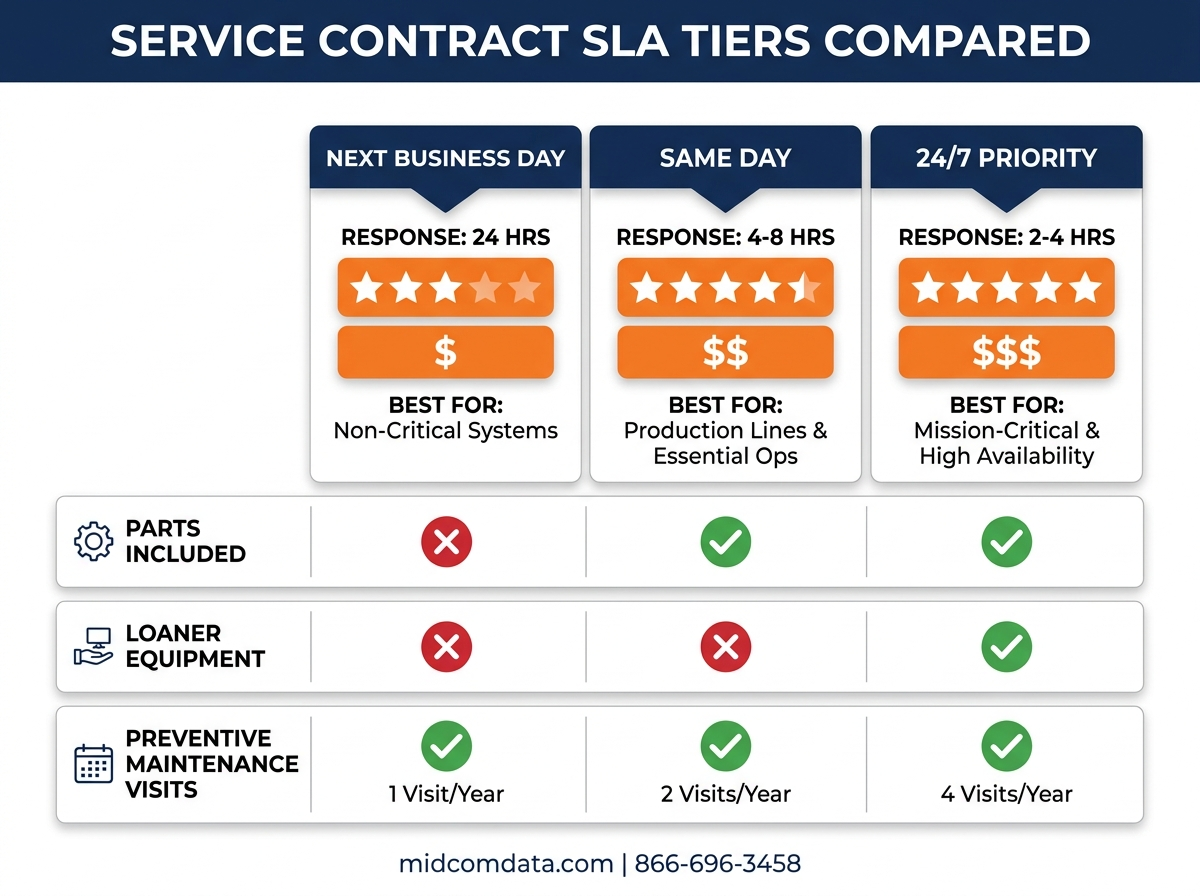
- Next business day (NBD): The technician arrives within one business day of your service call. This is the baseline for most contracts and works well for operations that have backup printers or can absorb a day of reduced throughput.
- Same day / 4-hour response: The technician is dispatched within four hours. This tier costs 25% to 40% more than NBD but is worth it for high-volume distribution centers and manufacturing lines where a single printer going down halts product flow.
- 24/7 coverage with 2-hour response: Reserved for mission-critical environments running multiple shifts. Expect to pay roughly double the NBD rate for this level of coverage.
Pay attention to whether the SLA guarantees “response” or “resolution.” Response means a technician will arrive or call within the stated window. Resolution means the printer will be fixed. Resolution guarantees are rare and more expensive, but if your operation cannot tolerate extended downtime, they are worth negotiating.
MIDCOM maintains a network of over 3,000 field technicians across the United States and Canada and offers same-day and next-business-day on-site printer repair in most metropolitan areas and many rural locations.
On-site repair vs. depot repair
Service contracts generally offer two repair models. The right choice depends on how critical each printer is and how much downtime you can absorb.
On-site repair
A technician comes to your facility and fixes the printer where it sits. This is the faster option and causes the least disruption. On-site contracts typically cost $300 to $900 per printer per year, depending on the make, model, and SLA tier. For printers running on a warehouse floor or production line where every hour of downtime costs money, on-site service pays for itself quickly.
Depot and express repair
You ship the printer to a repair center, where it is diagnosed, repaired, and shipped back. Turnaround ranges from 3 to 10 business days depending on the provider. Depot contracts are less expensive, often $150 to $400 per printer per year, and make sense for backup units, lower-volume printers, or offices where a few days without the printer is manageable. Some providers offer express depot repair with 24- to 48-hour turnaround for an additional fee.
Hybrid approach
Many organizations with mixed fleets put their high-volume, production-critical printers on on-site contracts and their secondary units on depot plans. This is a practical way to manage costs without leaving any printer uncovered. Ask your provider whether they offer tiered pricing across a fleet rather than forcing a single service level for every unit.
What to negotiate before you sign
Service contracts are not take-it-or-leave-it documents. Providers expect negotiation, especially on multi-printer or multi-year deals.
Multi-year discounts
A three-year commitment should come with a 10% to 20% discount over the single-year rate. If the provider does not offer this upfront, ask. Most will accommodate it because locking in recurring revenue benefits them too.
Fleet volume pricing
If you are covering 10 or more printers, you should receive per-unit pricing below the standard rate. The more printers on the contract, the stronger your negotiating position. Providers save on administrative overhead with larger accounts, and those savings should flow to you.
Loaner or swap units
For depot repairs, negotiate the inclusion of a loaner printer shipped to you within 24 hours so your operations are not interrupted during the repair window. Some contracts include this automatically. Others charge extra. Either way, get it in writing.
Cancellation and transferability
Confirm what happens if you decommission a printer mid-contract. Can the remaining term transfer to a replacement unit? Is there a prorated refund? Contracts that lock you into paying for printers you no longer own are a poor deal.
Hidden costs and red flags
Service contract pricing can obscure costs that eat into the value of the agreement. Watch for these issues before committing.
Per-incident deductibles. Some contracts advertise low annual fees but charge a $75 to $150 deductible per service call. Over a year with multiple calls, those deductibles add up and erode the value of the contract.
Consumables exclusions. Printheads are a gray area. Some providers classify them as consumables and exclude them from coverage. Clarify this in writing before signing. Labels, ribbons, and cleaning supplies are almost always excluded, which is standard and expected.
Travel surcharges. If your facility is outside a provider’s standard service area, you may face mileage or travel charges on top of the contract price. Ask whether your location falls within their coverage zone. Providers with large technician networks, like MIDCOM with technicians across the U.S. and Canada, are less likely to impose travel surcharges.
Auto-renewal clauses. Many contracts auto-renew at a higher rate unless you provide written cancellation 30 to 90 days before expiration. Mark the cancellation deadline on your calendar so you retain the option to renegotiate or switch providers.
Exclusion of older equipment. Some providers refuse to cover printers beyond a certain age, or they charge 30% to 50% more for older models. If your fleet includes legacy units, confirm they are eligible before assuming coverage.
Service contract ROI vs. break-fix
The financial case for a service contract comes down to predictability and total cost over time.
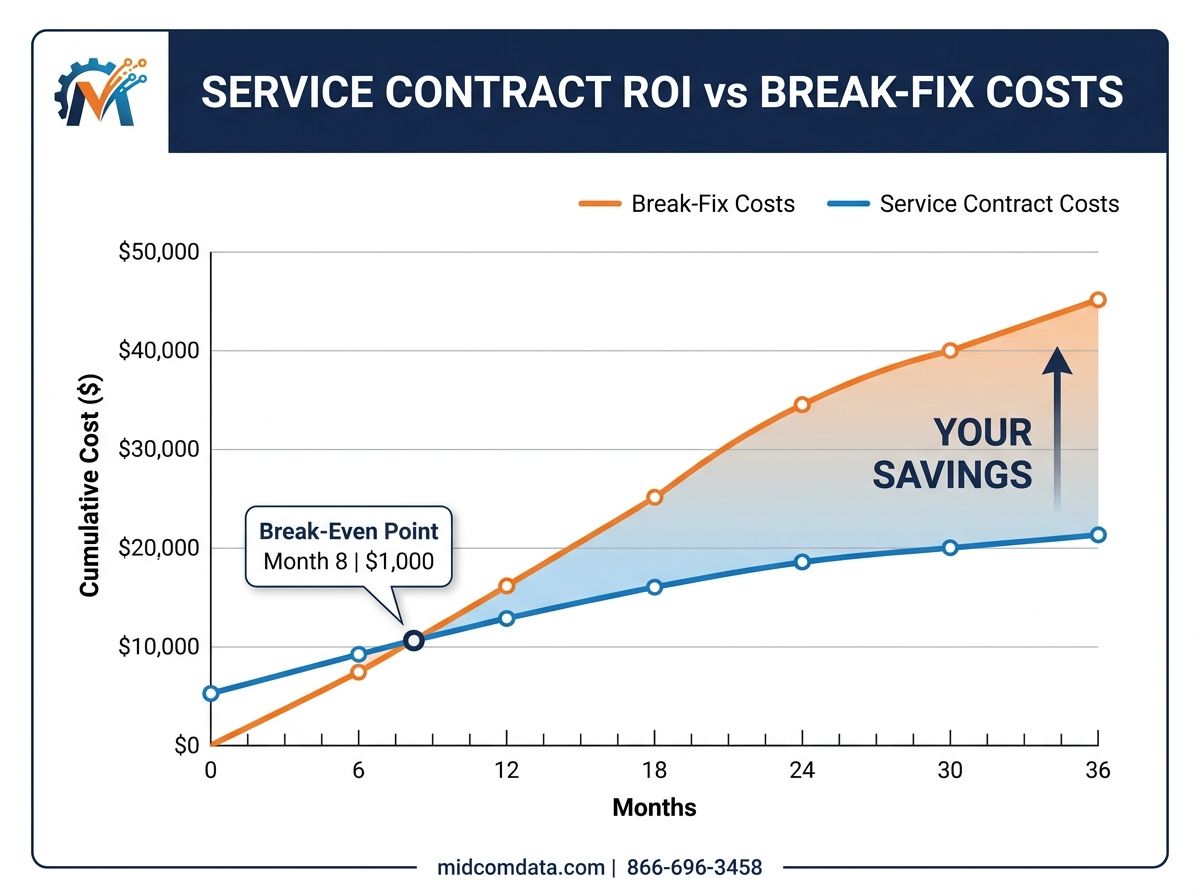
Suppose you operate 15 thermal barcode printers across two facilities. Without a service contract, each printer will need an average of 1.5 service events per year based on typical thermal printer failure rates. At an average repair cost of $450 per incident (parts plus labor), your annual break-fix spend is roughly $10,125, and that number swings unpredictably from month to month.
A service contract covering those same 15 printers at $500 per unit per year costs $7,500 annually. You save approximately $2,625 per year in direct repair costs, gain predictable budgeting, and avoid the hidden cost of procurement staff spending time sourcing repair vendors on short notice.
Factor in downtime costs and the math shifts further. If each unplanned printer failure causes two hours of reduced throughput and your operation values that throughput at $200 per hour, those 22.5 annual incidents represent $9,000 in productivity losses. A service contract with a same-day SLA cuts that downtime and the associated cost by 50% or more.
Break-fix makes sense only if you have a very small number of printers, strong in-house technical capability, and low sensitivity to downtime. For most operations running five or more printers, a service contract costs less than break-fix over a three-year period.
How to evaluate a service provider
A generous contract means nothing if the provider cannot deliver on it. Before signing, assess these areas:
- Technician network and geographic coverage. A provider with a handful of techs in one region will struggle to deliver consistent SLAs if you have multiple locations. MIDCOM Data Technologies, with over 3,000 technicians and more than 40 years in the industry, has the scale to support reliable nationwide coverage.
- Brand certifications. Confirm the provider’s technicians are factory-trained and certified on the specific printer brands in your fleet, whether that is Zebra, Honeywell, TSC, SATO, or others.
- Parts inventory. Providers who stock common parts can resolve issues faster than those who order parts after diagnosis. Ask whether they maintain regional parts depots.
- References from similar operations. Request references from customers with comparable fleet sizes and industries. A provider who does well with retail POS printers may not have the same expertise with high-volume industrial label printers.
Get a service contract quote for your fleet
If you are evaluating service plans for your barcode printer fleet, MIDCOM Data Technologies can build a contract matched to your equipment, locations, and uptime requirements. With 3,000+ technicians across the U.S. and Canada, same-day and next-business-day response options, and transparent pricing that includes printheads, MIDCOM has been servicing printer fleets for over four decades. Contact MIDCOM or call 866-696-3458 to request a no-obligation quote for your operation.
Frequently asked questions
How much does a barcode printer service contract cost?
A barcode printer service contract typically costs between $150 and $900 per printer per year. Depot-only plans fall on the lower end, while on-site contracts with same-day SLAs cost more. Multi-year and multi-printer volume discounts of 10% to 20% are common. The exact price depends on the printer model, service level, and geographic location.
What is the difference between a service contract and a warranty?
A manufacturer warranty covers defects in materials and workmanship for a limited period, usually one year. A service contract extends coverage beyond the warranty period and typically includes preventive maintenance, faster response times, and broader parts coverage including wear items like printheads that warranties often exclude.
Are printheads covered under barcode printer service contracts?
It depends on the provider. Some service contracts include printhead replacements at no additional charge, while others classify printheads as consumables and exclude them. Since printheads are the most frequently replaced and most expensive component in a thermal printer, confirm printhead coverage in writing before signing any agreement.
Can I get a service contract for older barcode printers?
Many providers cover printers that are up to 7 to 10 years old, though pricing may be higher for older models due to increased failure rates and harder-to-source parts. Some providers require an inspection or benchmark repair before enrolling older equipment. Contact the provider directly to confirm eligibility for your specific models.
Is a service contract worth it for a small number of printers?
For operations running five or more barcode printers, a service contract almost always saves money compared to break-fix repairs. For one or two printers, the calculation depends on how critical those printers are to your workflow. If a single printer going down halts shipping or production, a service contract is justified even for a small fleet because the cost of downtime far exceeds the annual contract fee.