Barcode Scanners for Cold Storage & Freezer Environments
Operating a barcode scanner in a cold storage or freezer environment requires more than just picking up the first rugged model you find. Standard warehouse scanners fail dramatically when exposed to temperatures below 50°F, condensation buildup, and the moisture and ice that accumulate on loading dock surfaces. This guide walks you through the specific challenges of cold storage scanning, the technical specifications that matter, and the proven scanner models that deliver in sub-zero conditions.
Why Standard Barcode Scanners Fail in Cold Environments
Most consumer and entry-level industrial scanners are rated for operating temperatures between 32°F and 104°F (0°C to 40°C). When you drop below that threshold, several things go wrong simultaneously:
Battery performance collapses. Lithium-ion batteries lose 30–50% of their capacity in freezing temperatures. A scanner that works for a full shift at room temperature may give you 2–3 hours in a -4°F freezer.
LCD screens become sluggish or unresponsive. The liquid crystal thickens, making touch interfaces lag and image rendering stutter.
Condensation destroys electronics. When a cold scanner moves from a freezer into a warmer dock area, moisture condenses inside the housing, corroding circuits within minutes.
Lens fogging prevents scans. Temperature differentials cause frost and condensation to form directly on the optical lens.
Plastic components become brittle. Seals, gaskets, and plastic housings become rigid in extreme cold, increasing crack risk.
Key Specifications for Cold Storage Barcode Scanners
Operating Temperature Range
Look for scanners rated for at least -4°F to 122°F (-20°C to 50°C). Enterprise-grade models handle -22°F (-30°C) or colder.
IP Rating (Ingress Protection)
For cold storage, you need IP54 or higher. IP54 means the device is dust-protected and can handle water spray from any direction. Many freezer facilities operate with regular washdown or defrost cycles, so moisture resistance is non-negotiable. Some models achieve IP65 or IP67.
Condensation Prevention
Premium cold storage scanners include vapor-phase or hydrophobic coating on internal components, and some models feature heated scan windows that prevent lens fogging.
Battery Performance in Cold
Verify that the manufacturer publishes battery life in cold conditions, not just room temperature specs. If battery life is listed only at room temperature, assume it’s 40–50% lower in freezing conditions.
Glove Compatibility
Your operators wear insulated gloves in cold storage. The scanner’s touchscreen, buttons, and optical trigger must work reliably through heavy winter gloves.
Top Barcode Scanner Models for Freezer Use
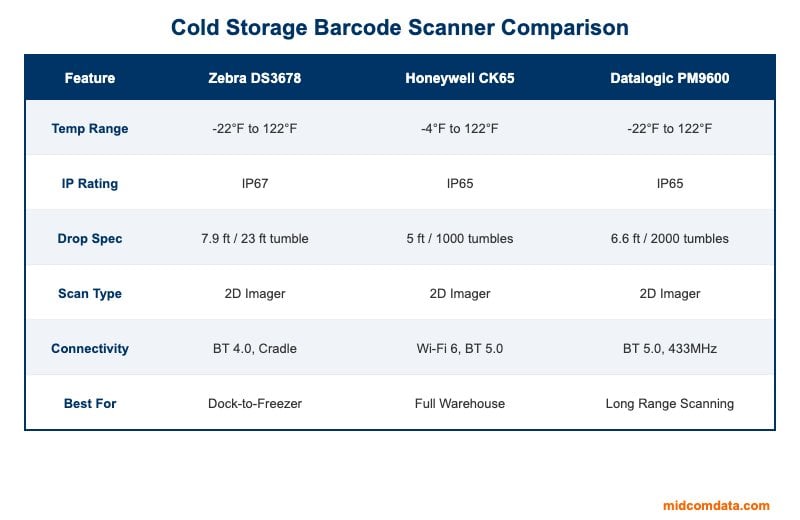
Zebra DS3678-SR is a workhorse in cold environments. It’s rated for -4°F to 122°F operation, has an IP67 rating, and includes Zebra’s heated optical window to prevent lens fogging. The battery maintains 70–80% capacity in extreme cold.
Honeywell Granit 1990iSR operates down to -22°F and includes corrosion-resistant stainless steel housing. It features a sealed battery compartment and extended-range cold batteries with glove mode.
Datalogic PowerScan 9600AR is rated for -4°F to 104°F and includes aggressive condensation controls and a low-light imager that works even when frost reduces visibility.
Cold Storage Barcode Scanner Specifications
Cold storage barcode scanner specifications compared across leading models.
Model
Operating Temp
IP Rating
Heated Window
Cold Battery Life
Glove Mode
Zebra DS3678-SR
-4°F to 122°F
IP67
Yes
8–10 hours
Yes
Honeywell Granit 1990iSR
-22°F to 122°F
IP65
Optional
7–9 hours
Yes
Datalogic PowerScan 9600AR
-4°F to 104°F
IP65
No
6–8 hours
Yes
Maintenance Tips for Cold Storage Scanners
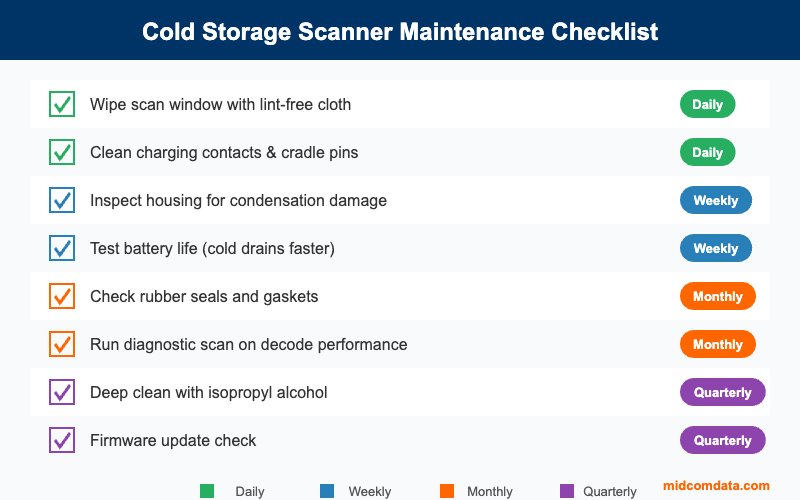
Follow this maintenance schedule to maximize cold storage scanner lifespan.
Acclimate scanners between temperature zones. Don’t pull a scanner from a -4°F freezer and immediately use it in a 70°F office. Allow 30 minutes for the device to warm gradually.
Inspect seals and gaskets monthly. Cold makes plastic rigid and can crack seals. Check battery compartment and charging ports for visible damage.
Clean optical windows with care. Use lint-free, alcohol-free cloths. In extremely cold and wet conditions, wipe the window every 2–3 hours.
Schedule professional service annually. Cold storage operations see more wear on batteries, optical components, and seals than standard warehouses.
Frequently Asked Questions
Can I use a regular warehouse barcode scanner in a walk-in freezer?
Not reliably. Standard scanners lose battery capacity, suffer screen lag, and are vulnerable to condensation damage. Cold-rated scanners are engineered specifically for this use case and are worth the investment.
What’s the difference between IP54 and IP67 for cold storage?
IP54 means dust-protected and water-resistant to spray. IP67 means fully dust-sealed and submersible to 1 meter. In a cold storage facility with regular washdown or defrost cycles, IP67 provides better protection.
How long will a barcode scanner battery last in a freezer?
A standard battery that lasts 10 hours at room temperature will typically last 4–6 hours in a -4°F freezer. Extended-capacity cold-rated batteries maintain 70–80% of room-temperature capacity.
Do I need to acclimate scanners when moving between freezer and dock areas?
Yes. Allow at least 30 minutes for a cold scanner to warm gradually. Rapid temperature changes cause condensation inside the housing, which can damage electronics even on sealed devices.
Can MIDCOM Data Technologies service scanners that fail in cold storage?
Yes. MIDCOM Data Technologies operates barcode scanner repair centers across the U.S. and Canada with technicians trained in cold storage equipment. We also offer a scanner buyback program if your equipment reaches end of life.
Choosing the Right Cold Storage Scanner
Start by confirming your facility’s actual operating temperature range, accounting for seasonal swings and defrost cycles. Then prioritize the specifications that matter: extended operating temperature, high IP rating, condensation controls, and cold-tested battery performance.
If you’re upgrading your current scanning infrastructure, browse MIDCOM’s barcode scanner catalog or contact our team for a quote. Founded in 1982, MIDCOM Data Technologies has 3,000+ technicians across the U.S. and Canada ready to help you deploy reliable scanning solutions in the coldest conditions. Explore rugged mobile tablets if you need to expand your cold storage data capture beyond barcode scanning.