
How to Choose the Right Barcode Label Material
Choosing the right barcode label material
Barcode label material has to be matched to three things: the surface it sticks to, the environment it lives in, and how long it needs to stay readable. Get any of those wrong and the label either falls off, becomes unreadable, or costs three times more than the job required. Paper labels run 1.5 to 3 cents each and work fine indoors for under six months. Synthetic labels cost 5 to 15 cents and survive years of chemicals, moisture, and sun.
Face stock: the label material itself
Paper
Coated or uncoated paper is the default for warehouse labeling, and for good reason — it’s the cheapest option and handles most indoor applications. Shipping labels, carton labels, pick labels, and short-term inventory tags are all paper jobs.
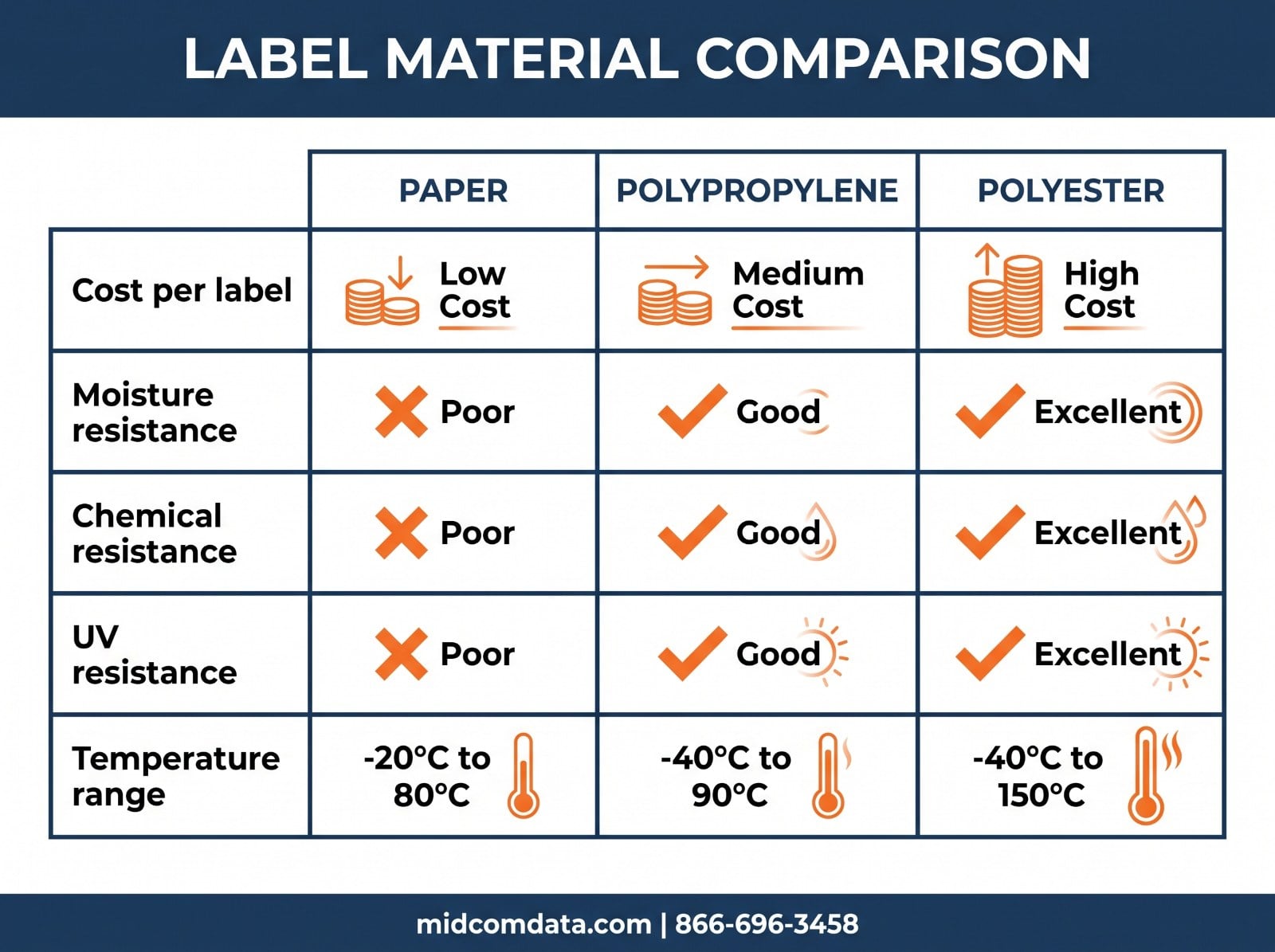
Paper’s limits are moisture and abrasion. It absorbs water, which wrinkles the face stock and smears the print. It tears. It has no chemical resistance. A paper label in a climate-controlled warehouse lasts 6 to 12 months easily; the same label in a walk-in cooler with condensation cycles fails in weeks.
Within paper there are two grades worth knowing. Uncoated paper is cheapest and works with direct thermal or wax ribbon. Coated (or “top-coated”) paper has a smooth clay layer that produces sharper barcode edges and better ribbon adhesion — worth the small premium if you’re printing dense barcodes or small labels.
Polypropylene (BOPP)
Polypropylene is the mid-tier synthetic. It’s waterproof, tear-resistant, and handles mild chemical exposure at roughly 3 to 4 times the cost of paper. This is the right material for cooler and freezer applications, product labels that get handled, and anything that might see incidental moisture.
Its ceiling is heat and UV. Polypropylene starts to distort above about 180°F and yellows with prolonged sun exposure. For indoor use with moisture, it’s ideal; for outdoor multi-year applications, it’s not enough.
Polyester (PET)
Polyester is what you buy when failure isn’t an option. It resists most industrial chemicals and solvents, tolerates temperatures from -40°F to over 300°F, holds up to years of UV exposure, and won’t tear. Asset tags, equipment nameplates, chemical drum labels, outdoor signage, and anything that goes through an autoclave or wash-down cycle should be polyester.
It costs 5 to 10 times more than paper and requires a resin ribbon, which is also the most expensive ribbon type. Use it where you need it and not where you don’t.
Specialty materials
A few situations call for something specific. Tag stock (heavy uncoated card, no adhesive) for hang tags and pallet placards. Void or destructible vinyl for tamper-evident asset tags that shred if removed. Tyvek for durable wristbands and tags that need to flex. Metallized polyester for equipment nameplates that need to look permanent.
Adhesive: the part people forget
Adhesive failure is more common than print failure, and it’s usually a spec mistake rather than a manufacturing defect.
Permanent acrylic
The standard adhesive for most labels. Bonds well to cardboard, plastic, and metal at room temperature, reaches full adhesion in about 24 hours, and is difficult to remove cleanly after that. Use this unless you have a reason not to.
Removable
Peels cleanly without residue for months after application. Correct choice for temporary shelf labels, bin markers you’ll reposition, promotional labels on retail packaging, and rental equipment tags. The tradeoff is that removable adhesive can release on its own under vibration or temperature swings, so don’t use it where the label absolutely must stay put.
Freezer-grade
Standard acrylic adhesive loses tack below about 20°F and won’t bond at all to a frozen surface. Freezer-grade adhesive is formulated to apply and hold down to -20°F or lower. Two things matter here: whether the label is applied at room temperature and then frozen (easier) or applied to an already-frozen surface (much harder, needs a true cold-apply adhesive). Specify which situation you have when ordering.
High-tack and aggressive
For low-surface-energy plastics (polyethylene, polypropylene containers), corrugated with heavy recycled content, powder-coated metal, and rough or dusty surfaces. Standard adhesive on a recycled corrugated carton often looks fine for a day and then lifts at the corners. If your labels are peeling off cartons, this is usually the fix.
Wash-off
Releases completely in a hot caustic wash. Required for returnable containers and reusable glass in food and beverage operations where the container gets relabeled each cycle.
Matching material to ribbon
If you’re printing thermal transfer, the ribbon has to match the face stock. Mismatches are the most common cause of print that rubs off.
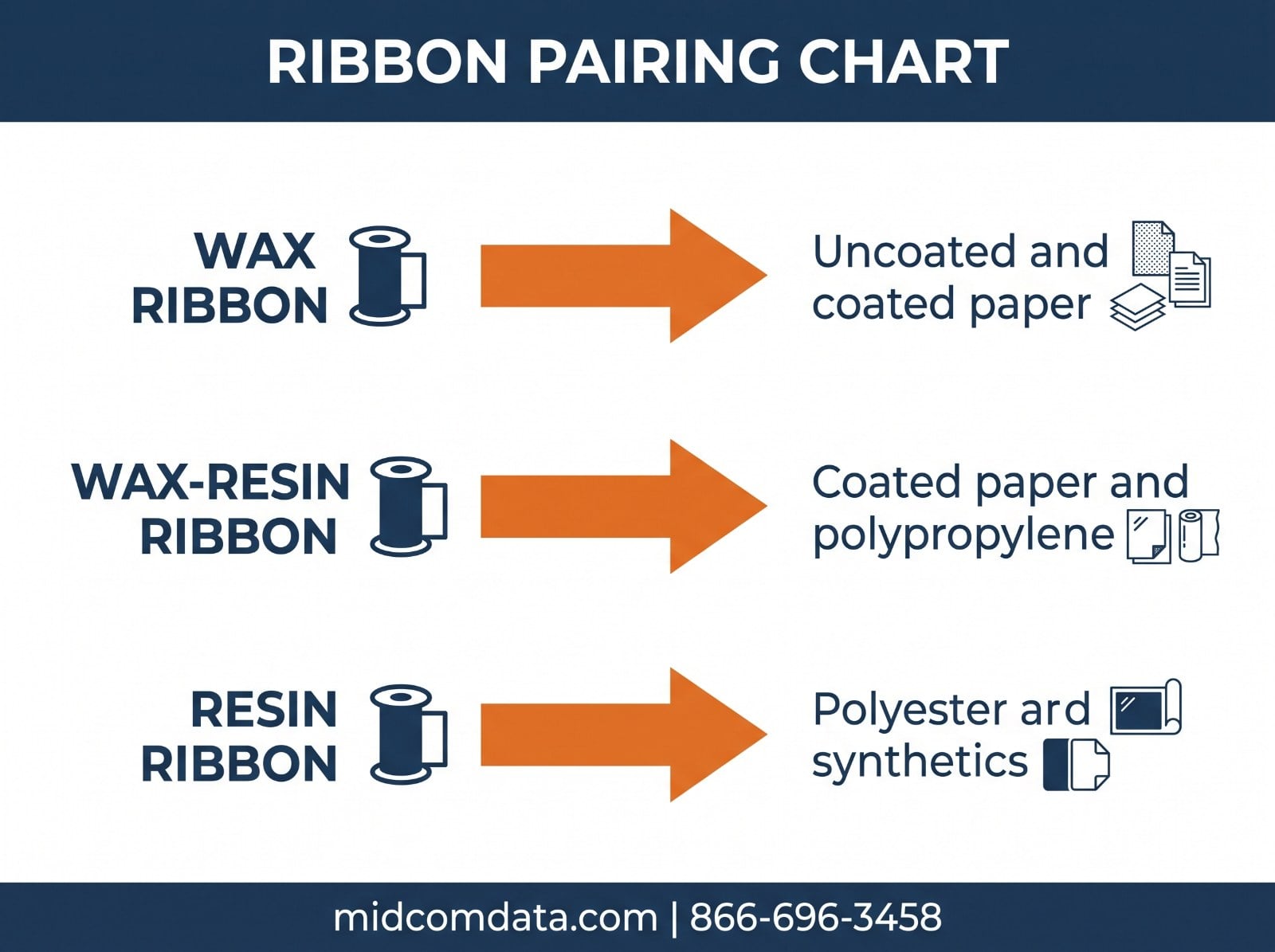
Wax ribbon pairs with uncoated and coated paper. Cheapest ribbon, good print speed, but the image smudges under friction and won’t adhere properly to synthetics.
Wax-resin pairs with coated paper and light synthetics like polypropylene. Noticeably more smear-resistant than wax, moderate cost. This is the safe middle choice for labels that get handled.
Resin pairs with polyester and other synthetics. Most durable and chemical-resistant, most expensive, and needs higher printhead temperature which means slower print speeds. Required for polyester — wax or wax-resin on polyester will scratch off.
The rule of thumb: wax for paper, wax-resin for coated paper and polypropylene, resin for polyester. MIDCOM stocks labels and ribbons matched to every major printer brand, and we’ll confirm the pairing when you order rather than letting you find out after the first roll.
Matching material to environment
Working backward from conditions is the most reliable way to spec a label. Common scenarios:
Climate-controlled warehouse, under 6 months: Direct thermal paper or paper with wax ribbon, permanent acrylic adhesive. Cheapest option that works.
Climate-controlled, 6 months to 2 years: Paper with wax-resin ribbon, permanent adhesive. Thermal transfer rather than direct thermal, since direct thermal fades.
Cooler (35 to 45°F) with condensation: Polypropylene with wax-resin ribbon, permanent or freezer-grade adhesive depending on application temperature.
Freezer (-10 to -20°F): Polypropylene or polyester with resin ribbon, freezer-grade adhesive. Specify whether you’re applying to a frozen surface.
Outdoor, multi-year: Polyester with resin ribbon, permanent adhesive, and consider over-lamination for UV protection. Adds 1 to 3 cents per label but extends readable life substantially.
Chemical exposure or wash-down: Polyester with resin ribbon, aggressive permanent adhesive. Over-lamination if the chemicals are harsh or contact is direct.
High heat (over 200°F): Polyester with resin ribbon, high-temperature adhesive. Verify the specific temperature rating — “high temp” means different things across suppliers.
If your labels are currently failing and you’re not sure which variable is the problem, our post on why barcode labels fade walks through diagnosing print degradation versus adhesive failure versus printer calibration.
Testing before you commit
Order a sample roll and test it in your actual conditions before buying a pallet. A material that performs perfectly in a supplier’s lab can fail on your specific carton stock.
Apply a few labels to the real surface, in the real environment, and leave them for as long as you practically can. Check adhesion at 24 hours (full bond) and again at whatever interval matters for your application. Scan them with your actual scanners, not a phone. Then abuse a couple — rub them, wet them, freeze them, whatever the application involves — and see what holds.
Also worth checking: run the sample through your printer at production speed. Some synthetic materials need slower speeds or higher darkness to print cleanly, and if that drops your throughput below what a station needs, that’s a real cost you want to know about beforehand.
MIDCOM Data Technologies has been supplying labels, ribbons, and printers to warehouse and manufacturing operations since 1982, with service coverage across the U.S. and Canada. If you’re specifying labels for a new application or troubleshooting ones that keep failing, call 866-696-3458 or request samples and a quote. We’ll spec the combination that works rather than the one with the highest margin.
Frequently asked questions
What is the difference between paper and synthetic barcode labels?
Paper labels cost 1.5 to 3 cents each and work well indoors for under six months, but they absorb moisture, tear, and have no chemical resistance. Synthetic labels (polypropylene or polyester) cost 3 to 10 times more but resist water, chemicals, temperature extremes, and UV exposure for years.
Why do my labels keep peeling off cartons?
Usually the adhesive is wrong for the surface. Corrugated with high recycled content, low-surface-energy plastics, and dusty or rough surfaces all need a high-tack aggressive adhesive rather than standard permanent acrylic. Cold application temperature is the other common cause — standard adhesive won’t bond below about 20°F.
What label material should I use for freezer storage?
Polypropylene or polyester face stock with a resin ribbon and a freezer-grade adhesive rated to -20°F or lower. Specify whether labels are applied at room temperature and then frozen, or applied directly to an already-frozen surface, because those require different adhesives.
Which ribbon goes with which label material?
Wax ribbon for uncoated and coated paper. Wax-resin for coated paper and polypropylene. Resin for polyester and other synthetics. Using wax on a synthetic label produces print that rubs off, and using resin on plain paper works but costs several times more than necessary.
Do I need over-lamination on my labels?
Over-lamination is worth it for labels facing prolonged UV exposure, heavy abrasion, or direct chemical contact — asset tags, outdoor equipment labels, and high-value product labels that need to stay readable for years. It adds roughly 1 to 3 cents per label. For indoor labels with a life under a year, it’s unnecessary.