
UDI Labeling for Medical Devices: Barcode Requirements
What a UDI is and what it’s for
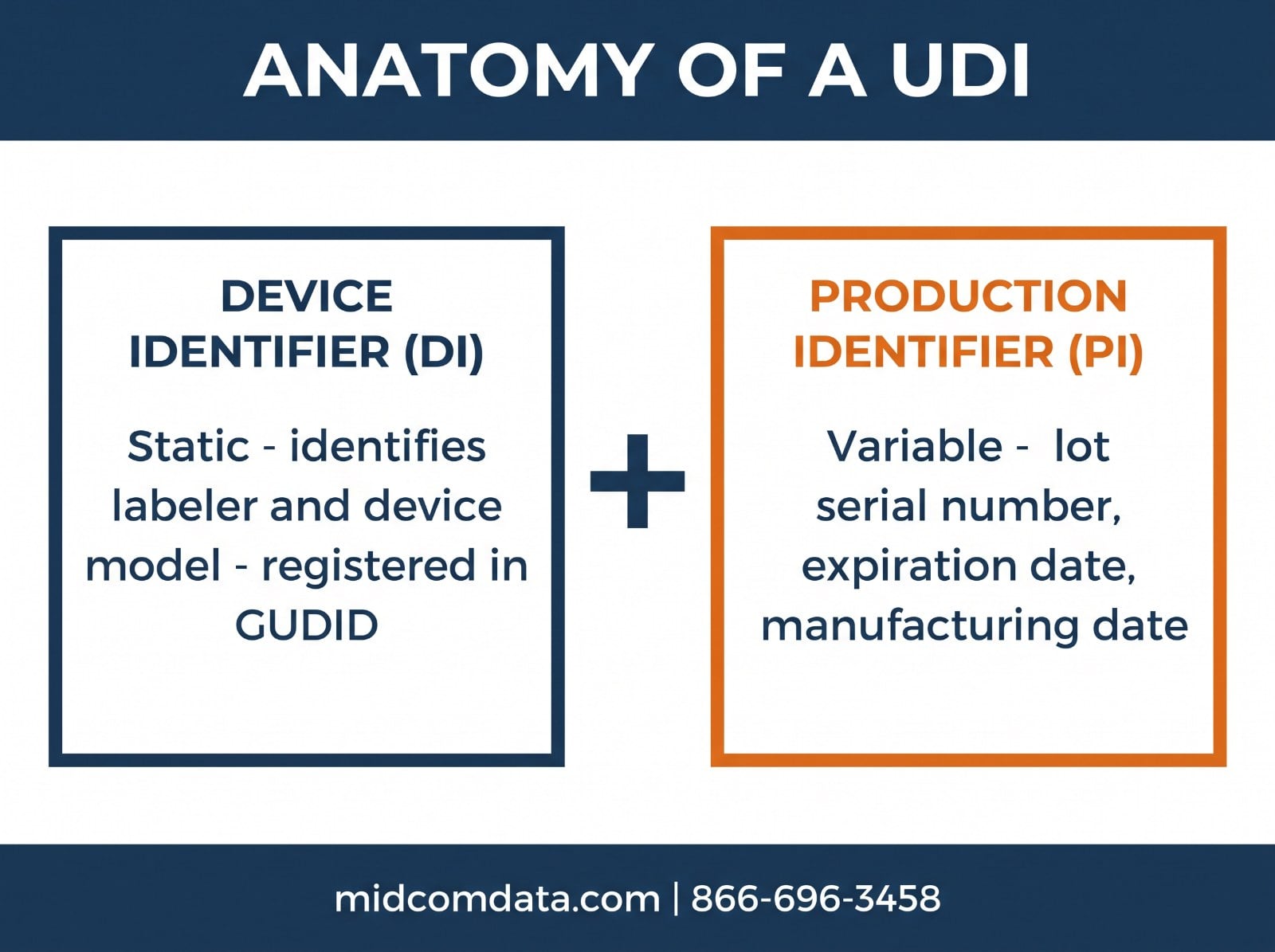
A Unique Device Identifier is a code that identifies a specific medical device through its distribution and use. It has two parts: a Device Identifier that says what the product is, and a Production Identifier that says which unit or batch this is. Under FDA rules, the UDI must appear on the device label in both human-readable text and a machine-readable barcode, and the Device Identifier must be registered in the FDA’s Global Unique Device Identification Database. The regulation is settled — the phase-in by device class is complete — so for a device manufacturer today the question isn’t whether to comply but how to print it correctly.
The two halves of a UDI
Device Identifier (DI)
The DI is the static part. It identifies the labeler (the manufacturer or whoever is responsible for labeling) and the specific version or model of the device. Every unit of the same model carries the same DI. This is the part that goes into GUDID along with the device’s attributes — name, description, size, whether it contains latex, and so on.
Production Identifier (PI)
The PI is the variable part, and it’s whatever production data applies to that device: lot or batch number, serial number, expiration date, manufacturing date, and for certain products a distinct identification code. Not every device needs every PI element. A sterile single-use item typically carries lot and expiration. An implant usually carries a serial number. The labeler decides which PI elements apply based on how the device is controlled.
The PI is never submitted to GUDID — the database holds only the DI and its attributes. The PI lives on the label and travels with the physical device.
Who issues the identifiers
The FDA doesn’t issue UDIs directly. It accredits issuing agencies whose numbering systems meet the requirements, and labelers obtain identifiers from one of them. Three agencies are accredited.
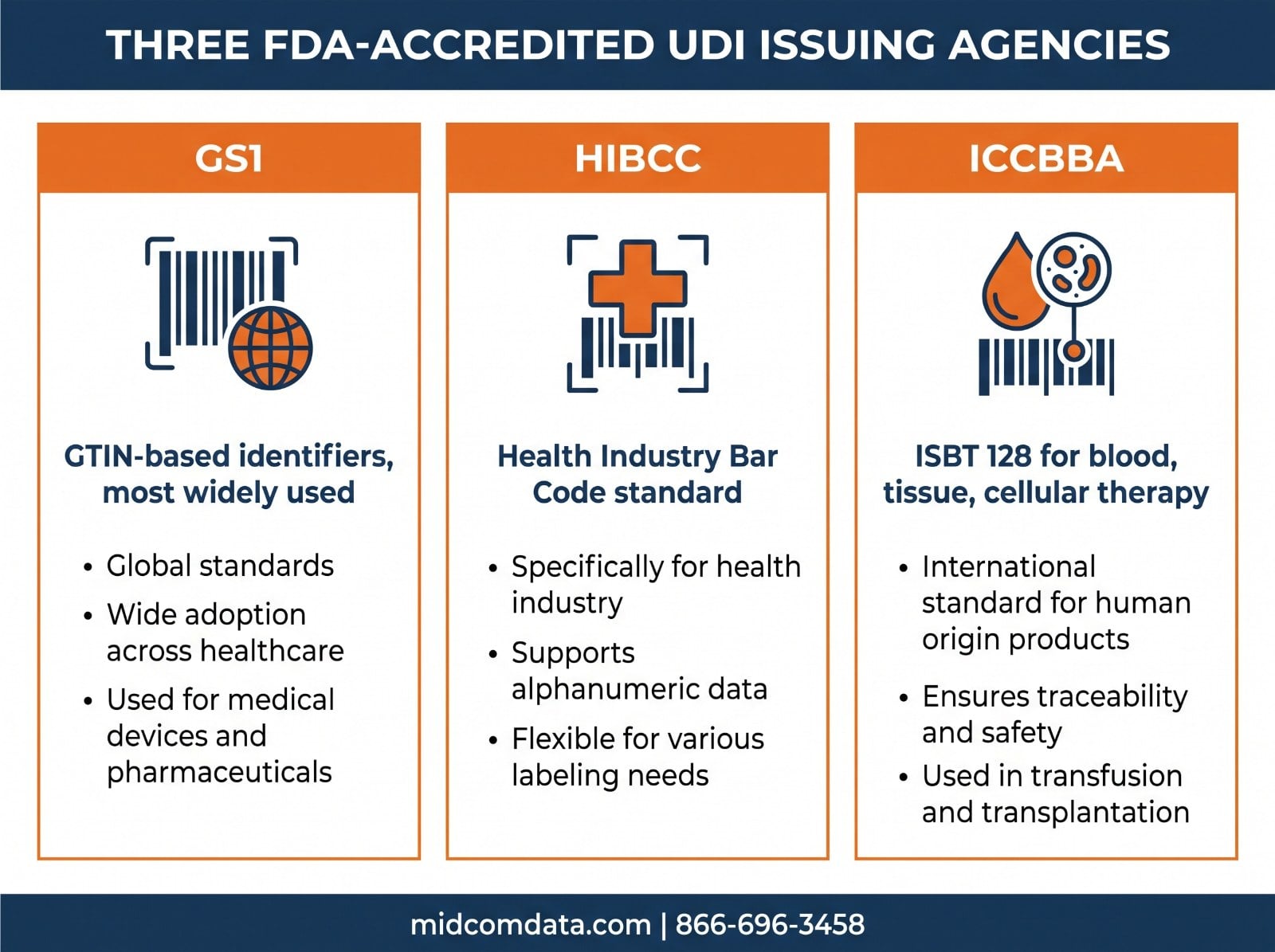
GS1 is the most widely used. The DI is a GTIN (Global Trade Item Number), the same family of identifiers used on retail products, and the PI elements are encoded using GS1 Application Identifiers — the same system that drives GS1-128 shipping labels. If you already have a GS1 company prefix for other products, this is usually the path of least resistance.
HIBCC (the Health Industry Business Communications Council) issues identifiers under the Health Industry Bar Code standard. It’s been in healthcare longer than GS1 and remains common among device manufacturers who adopted it before UDI existed.
ICCBBA issues identifiers under the ISBT 128 standard, which is specific to blood, tissue, cellular therapy, and related products of human origin. If you make those, this is your agency; if you don’t, you’ll use one of the other two.
The format of the UDI — how it’s structured and which barcode symbologies carry it — depends on which agency you use. The FDA publishes a document describing each accredited agency’s approved formats, and it’s updated periodically. Check the current version before finalizing a label design.
Barcode symbology choices
The UDI rule requires a machine-readable form but doesn’t mandate a single symbology. In practice three carry most UDIs.
GS1-128 is the linear option under GS1. It encodes DI and PI with Application Identifiers in a single barcode or two. It’s long — a full UDI with lot and expiration can run past three inches at a readable size — which limits where it fits. Common on outer packaging and larger device labels.
GS1 DataMatrix is the 2D option under GS1 and the dominant choice for device-level labeling. It encodes the same data in a small square, often under half an inch, and includes error correction so a partially damaged symbol still reads. If label space is tight — and on devices it usually is — this is the answer.
HIBC symbols under HIBCC use Code 128 or Data Matrix with HIBC-specific data structures. Same tradeoffs: linear for space, 2D for density.
Whatever symbology you choose, the human-readable interpretation has to appear alongside it, so a clinician or inventory system without a scanner can still read the identifier.
Direct marking
Direct marking means putting the UDI on the device itself, not just the label or packaging. Under 21 CFR 801.45, this is required for devices intended to be used more than once and reprocessed before each use — surgical instruments, reusable endoscopy components, and similar. The logic is that the packaging gets thrown away after the first use, so the identifier has to survive on the device through repeated cleaning and sterilization.
Direct marking is done by laser etching, dot peen, or a durable printed mark, depending on material. A permanent-marking thermal transfer label on a polyester or polyimide stock can qualify for some devices, but for anything that goes through an autoclave repeatedly, laser marking is the reliable route.
The direct mark can carry the same UDI as the label, or a separate DI specific to the direct mark. Either is permitted; what matters is that it’s permanent and readable for the device’s expected life.
Printing UDI labels correctly
The regulatory structure is one thing. Getting a readable, durable label out of a thermal printer is the practical half.
Print quality has a standard
GS1 and HIBCC both reference ISO/IEC 15415 (for 2D) and 15416 (for linear) print quality grading, and GS1 healthcare specifications set minimum grades. A Data Matrix that scans fine on your bench but grades a D is a compliance risk, because the hospital’s scanner may not be as forgiving as yours. Our post on barcode verification and print quality grades covers what the grades mean and how to keep them up.
Resolution matters more here
Small Data Matrix symbols with dense data need a printer that can place dots precisely. A 203 DPI printer can produce a readable Data Matrix if the symbol is large enough, but device labels rarely have that room. 300 DPI is the practical minimum for most UDI device labels, and 600 DPI is common for very small devices and vials.
The label has to survive the device’s life
A UDI label on a sterile pouch has an easy life. A UDI label on a device that’s stored, shipped, handled, and possibly disinfected needs to stay readable through all of it. Synthetic face stock — polyester or polypropylene — with a resin ribbon is standard, and lamination or a protective overlay is common for anything that sees chemicals. Our label material guide covers the pairings.
Variable data has to be right every time
The PI changes with every lot or serial, so the label system has to pull it from production data rather than relying on someone typing it. A wrong lot number on a UDI label is a recall-grade problem. Label software that integrates with your manufacturing system and generates the barcode from the data — rather than from typed text — is not optional at this level.
MIDCOM Data Technologies supplies 300 and 600 DPI thermal printers suited to UDI labeling, along with the synthetic media and resin ribbons the application calls for. If you’re setting up or auditing a UDI labeling line, call 866-696-3458 or request a consultation.
Common mistakes
A few things come up repeatedly when UDI labels fail inspection or cause downstream problems.
Printing the barcode too small for the printer’s resolution, so modules blur together and the grade drops. The fix is either a larger symbol or a higher-DPI printer.
Putting the human-readable text in a font or size that’s hard to read, or omitting it. The rule requires both forms.
Encoding the PI in a different order or format than the issuing agency specifies. GS1 Application Identifiers have required sequences and formats — an expiration date encoded as MMDDYY instead of YYMMDD will scan but mean the wrong thing.
Using a label material that doesn’t survive the device’s handling, so the UDI is unreadable by the time the device reaches the point of use.
Not verifying. A verifier is a real cost, but for UDI labels it’s cheap insurance against a label lot that grades F going out the door.
MIDCOM Data Technologies has supplied labeling and barcode hardware to manufacturers since 1982, with service across the U.S. and Canada. Get in touch or call 866-696-3458 to talk through your UDI printing setup.
Frequently asked questions
What is a UDI on a medical device?
A Unique Device Identifier is a code required by the FDA on medical device labels, in both human-readable and barcode form. It combines a Device Identifier, which identifies the labeler and the specific device model, with a Production Identifier carrying lot, serial, expiration, or manufacturing date as applicable. The Device Identifier is registered in the FDA’s GUDID database.
Who can issue a UDI?
Three FDA-accredited issuing agencies: GS1, which uses GTIN-based identifiers and is the most widely adopted; HIBCC, which issues Health Industry Bar Code identifiers; and ICCBBA, which issues ISBT 128 identifiers for blood, tissue, and cellular therapy products. The labeler obtains identifiers from one of these, not from the FDA directly.
What barcode is used for UDI?
Most commonly GS1 DataMatrix for device-level labels, because it encodes the full UDI in a small square with error correction. GS1-128 is used where there’s room for a linear barcode, typically on outer packaging. HIBCC labelers use HIBC-formatted Code 128 or Data Matrix. The rule requires a machine-readable form but doesn’t mandate one symbology.
When is direct marking required for UDI?
Under 21 CFR 801.45, a device that must carry a UDI on its label also needs a permanent UDI marked on the device itself if it’s intended to be used more than once and reprocessed before each use. Surgical instruments and reusable components are typical examples. The mark must survive the device’s expected life, which for autoclaved items usually means laser marking.
What printer resolution do I need for UDI labels?
300 DPI is the practical minimum for most device-level UDI labels, because the Data Matrix symbols are small and dense. 600 DPI is common for very small devices and vials. A 203 DPI printer can work only if the label has room for a large symbol, which device labels rarely do.