
Warehouse Rack, Bin, and Location Labeling Systems
Why location labeling decides your pick accuracy
A warehouse location labeling system is the addressing scheme that tells every worker and every scan exactly where something is. Get it right and a new hire finds a bin on their first day. Get it wrong and you spend years working around it, because renumbering a live warehouse means touching every location, every WMS record, and every printed pick list at once. The labeling decisions you make at setup are the ones you live with longest.
Designing the location naming scheme
Most warehouses use some version of aisle, bay, level, position. A location like A12-03-C-2 reads as aisle A12, bay 03, level C, position 2. The specific format matters less than consistency, but a few rules save real pain later.
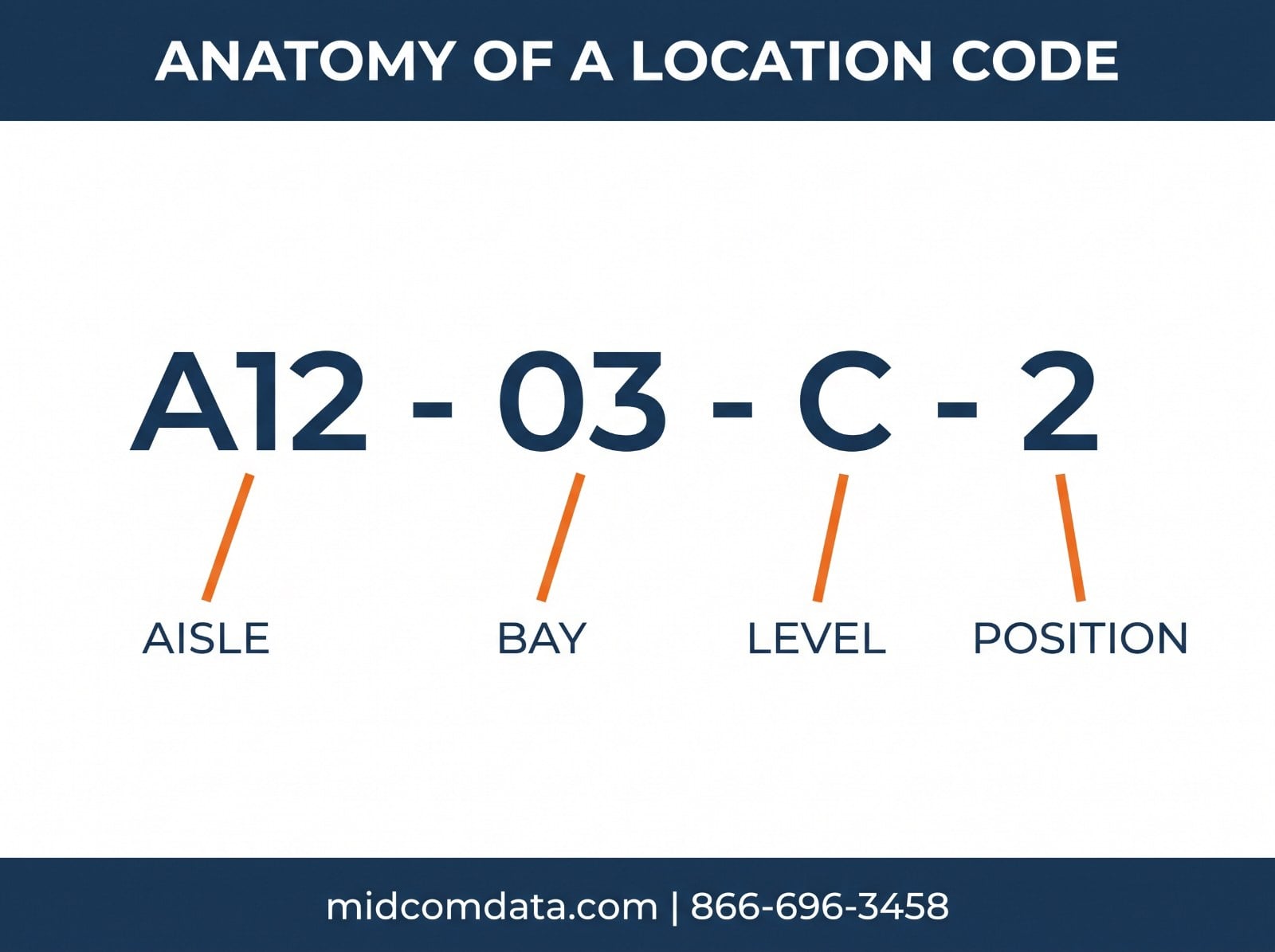
Pad your numbers
Use A01 rather than A1. The moment you have more than nine aisles, unpadded numbers sort wrong in every system that touches them — A10 sorts before A2, and your pick paths start zigzagging. Two digits handles most warehouses; three if you’re above 99 of anything.
Leave gaps in the sequence
Number aisles 10, 20, 30 rather than 1, 2, 3. When someone adds a rack run between two existing aisles in three years, you can call it 15 instead of renumbering half the building. The same applies to bays in a run you might extend.
Make levels unmistakable
Letters for levels (A at floor, B above it) rather than numbers avoids ambiguity when someone reads a location aloud or writes it on a pallet. “A12-03-2-2” is easy to transpose; “A12-03-B-2” is not.
Keep the scheme readable by humans
Workers will read these aloud, write them on cartons, and call them out over a radio. A location that’s easy to say is easy to get right. This is also why some operations avoid letters that sound alike over a noisy PA — B, D, E, and P are the usual offenders.
Label types by location
Rack beam labels
The workhorse. These go on the horizontal beam face at each pallet position, typically a polyester or polypropylene label with permanent adhesive. Standard practice is one label per pallet position rather than one per bay, so a scan is unambiguous about which of three pallets someone is looking at.
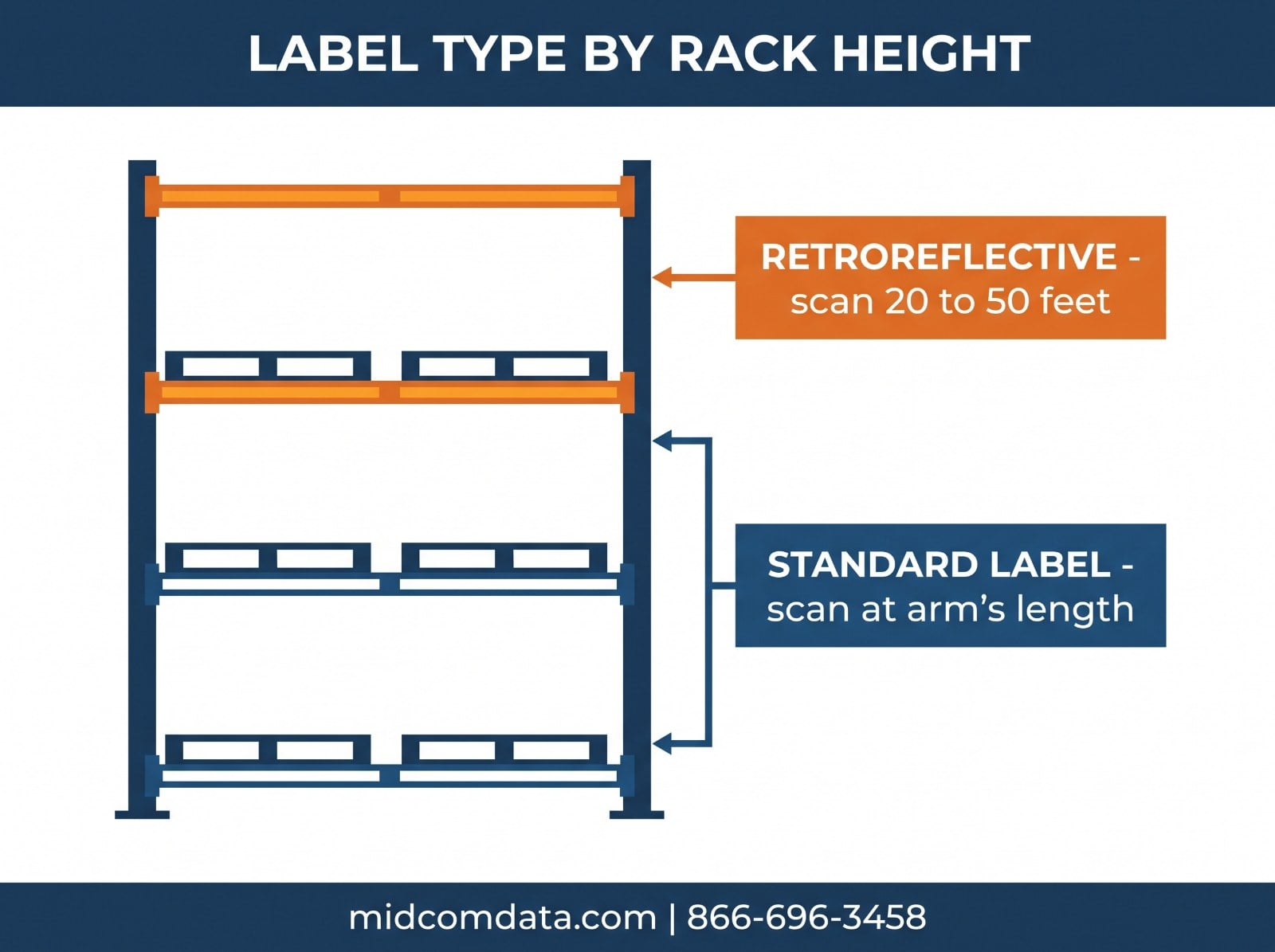
Size them for the read distance. A picker standing at the beam can scan a 2-inch label. A forklift operator sitting 15 feet up needs something much larger, or retroreflective material.
Long-range retroreflective labels
Retroreflective labels have a finish that bounces the scanner’s beam straight back along its incoming path rather than scattering it. That lets a forklift operator scan an upper-level location from the aisle floor without climbing or repositioning. Paired with a long-range scanner, these read reliably at roughly 20 to 50 feet depending on label size, scanner model, and lighting.
They cost several times a standard label, so most operations use them only above the second level, where reaching the location by hand isn’t practical. Below that, standard labels are fine and a lot cheaper.
Aisle and zone signage
Overhead hanging signs and aisle-end placards orient people before they get to the specific location. These are usually printed on heavier stock or rigid substrate rather than label material, and they carry the aisle identifier in large type plus the location range in that aisle.
Double-sided hanging signs are worth the extra cost — a sign readable from only one direction sends half your traffic past it.
Floor locations and bulk storage
Floor-level bulk and staging areas need markings that survive forklift traffic. Options run from floor-applied labels with protective laminate, to placards mounted on posts or bollards at the edge of each block, to labels on the rack upright at the corner of the zone. Floor-applied anything takes abuse; mounting at eye level on a fixed object lasts far longer.
Bin and shelf locations
Small-parts shelving and bin locations use smaller labels, often with a magnetic or removable backing because these reconfigure more often than pallet racking does. Magnetic label holders on steel shelving let you reorganize a pick face without scraping adhesive.
Material and adhesive choices
Location labels are a long-life application — you want them readable in five years, not six months. That rules out plain paper for anything permanent.
Polyester with resin ribbon is the default for rack labels. It resists abrasion from pallets sliding past, doesn’t absorb moisture, and holds print quality for years.
Adhesive should be a high-tack permanent for painted or powder-coated rack beams. Standard acrylic often looks fine on installation day and lifts at the corners within a month, because powder-coated steel is a lower-energy surface than it appears.
Cold storage needs freezer-grade adhesive rated to the temperature you actually run. Also worth knowing: applying labels to already-frozen steel requires a cold-apply adhesive, which is different from an adhesive that merely survives freezing after room-temperature application. Specify which situation you have when you order.
Over-lamination is worth considering for labels at pallet-strike height. A clear laminate takes the scuffing that would otherwise destroy the barcode.
MIDCOM stocks label stock, ribbons, and specialty media for rack and location labeling, including retroreflective and freezer-grade options. Call 866-696-3458 if you’re not sure which combination fits your racking and climate.
Scanner requirements for location scanning
Location labels drive your scanner spec more than product labels do, because the read distances are longer and more variable.
A picker scanning bin locations at arm’s length works fine with a standard-range imager. A forklift operator scanning a level-D location from the floor needs an extended-range model — something like the Zebra DS3678-ER, which is built for retroreflective long-range reads. If you mix both use cases on one device, the extended-range unit handles near reads too, but check the minimum focus distance, because some long-range scanners struggle up close.
Vehicle-mounted scanning is the other common setup. A fixed-mount or vehicle-cradled scanner on the forklift, paired with a mobile computer on the mast, means the operator scans without handling a device. Our guide on reading scanner spec sheets covers how to interpret the range and focus numbers.
Browse MIDCOM’s scanner catalog or call us to talk through which models fit your rack heights.
Planning a relabeling project
If you’re relabeling an existing warehouse rather than setting up a new one, sequencing matters more than materials.
Map before you print. Walk the building and record every location that exists now, including the ones that aren’t in the WMS. Every warehouse has a few. Build the new scheme against reality rather than against the system’s idea of reality.
Print and stage by aisle. Labels sorted into aisle-by-aisle kits let a two-person crew work a run without sorting on the floor. Label a full aisle before moving on rather than doing all the level-A locations building-wide.
Cut over the WMS in step with the physical labels. The dangerous window is when the system says one thing and the beam says another. Most operations do this aisle by aisle over a weekend, or run a crosswalk table that accepts both old and new codes during the transition.
Budget for extras. Damaged labels, locations you missed in the survey, and racking that gets reconfigured mid-project all consume stock. Ten percent over your counted location total is a reasonable buffer.
MIDCOM Data Technologies has been supplying warehouse labeling and scanning hardware since 1982, with service across the U.S. and Canada. If you’re planning a labeling project and want a second opinion on materials or scanner selection, get in touch or call 866-696-3458.
Frequently asked questions
What is the best warehouse location naming convention?
Aisle-bay-level-position is the most common structure, written like A12-03-C-2. Pad numbers to two digits so they sort correctly, leave gaps in the sequence so you can insert new aisles later without renumbering, and use letters for levels so locations are harder to transpose when read aloud.
How far away can retroreflective rack labels be scanned?
Retroreflective labels paired with an extended-range scanner read reliably at roughly 20 to 50 feet, depending on label size, scanner model, and lighting. The retroreflective finish returns the scanner’s beam along its incoming path instead of scattering it, which is what makes the long read possible.
What label material should I use for warehouse rack labels?
Polyester face stock with a resin thermal transfer ribbon and a high-tack permanent adhesive. Powder-coated rack beams are a lower-energy surface than they look, so standard acrylic adhesive tends to lift at the corners. Cold storage needs freezer-grade adhesive, and applying to already-frozen steel requires a cold-apply formulation specifically.
Do I need special scanners for rack location labels?
Only for elevated locations. Bin and floor-level scanning works with any standard-range imager. Reading upper rack levels from the aisle floor requires an extended-range scanner such as the Zebra DS3678-ER, designed for long-range retroreflective reads. Check the minimum focus distance if the same device also has to scan up close.
How do I relabel a warehouse without disrupting operations?
Survey every physical location first, including ones missing from the WMS. Print and stage labels in aisle-by-aisle kits, then work one aisle at a time, cutting the WMS over in step with the physical labels so the system and the beam never disagree for long. Order about 10% extra to cover damage and locations missed in the survey.